Can You Play Pickleball on a Basketball Court?
Quick Answer: Yes. Under the 2026 rulebook, a pickleball court measures 20 feet by 44 feet, small enough to fit inside a 94 by 50 foot NBA or college basketball court, an 84 by 50 foot high school gym floor, or a public park’s outdoor court, using a portable net and tape or painted lines instead of permanent posts.
A basketball court is one of the easiest spaces to convert for pickleball because the numbers work in its favor. A regulation pickleball court measures 20 feet wide by 44 feet long under Section 3 of the 2026 rulebook, a specification covered in full in the guide to pickleball court dimensions. An NBA or NCAA basketball court measures 94 feet long by 50 feet wide. Two 20-foot-wide pickleball courts placed side by side total 40 feet, which fits inside that 50-foot width with 10 feet left over, and two 44-foot pickleball courts placed end to end total 88 feet, which fits inside the 94-foot length with 6 feet to spare. That means a full NBA or college gym floor has room for a two-by-two grid of four pickleball courts, using 40 of the available 50 feet in width and 88 of the available 94 feet in length. That 20 by 44 foot playing surface does not include the extra run-off space recommended around each court, a buffer covered in the guide to how much space a pickleball court needs, but a basketball court’s out-of-bounds area typically absorbs it without any extra construction.
How Many Pickleball Courts Fit on a High School Gym Floor?
A National Federation of State High School Associations court measures 84 feet long by 50 feet wide, ten feet shorter than an NBA or college gym floor. The width math stays the same: two 20-foot pickleball courts fit side by side across the 50-foot width, again with 10 feet to spare. The length math changes, though. A single 44-foot pickleball court leaves 40 feet of the 84-foot gym floor open, but a second 44-foot court end to end would need 88 feet, four feet more than the floor provides. A high school gym therefore fits two pickleball courts side by side in one row rather than the four-court grid a full-length college or NBA floor allows.
How Does the Gym Floor Surface Affect a Pickleball Bounce?
Not every gym floor plays the same once a pickleball bounces on it. A court-surfacing guide from Pace Court describes hardwood as giving a smooth, controlled bounce with strong traction, though extended play on bare hardwood can strain joints without a cushioned subfloor. The same guide describes modular sport court tile as adding a slightly flexible feel underfoot, while noting bounce can vary with tile thickness and sub-base quality, one reason some tournament directors still prefer acrylic-over-concrete surfaces. None of that changes what counts as a legal court, since the rulebook governs dimensions and equipment, not the flooring underneath.
What Nets and Lines Turn a Basketball Court Into a Pickleball Court?
A basketball court has no net posts sunk into the floor, so portable pickleball nets take their place. Regulation portable nets span 22 feet, one foot wider than the court’s 20-foot sideline-to-sideline distance on each side, and stand 36 inches tall at the sidelines and 34 inches at the center, matching the net specifications in Section 3 of the 2026 rulebook. Net weight varies by model, from lightweight nets under 20 pounds to heavier steel-frame nets on rolling bases for a gym with a fixed weekly schedule. The center height matters, since a sagging strap changes how a drop shot clears the net, a detail covered in the guide to the height of a pickleball net.
Lines matter as much as the net. Basketball lane lines, the three-point arc, and the center circle bear no relationship to a 20 by 44 foot pickleball court, so a converted gym needs its own lines added on top, usually in a contrasting color so players can tell the two sports apart at a glance.
Painted Lines vs Tape: How Do Facilities Dual-Stripe a Basketball Court?
Facilities converting a basketball court for regular pickleball play choose between temporary tape and permanent dual-striped paint. Tape suits a one-off community night or a single tournament weekend, since it peels up afterward without damaging the basketball court’s own lines, but it wears out fast under foot traffic and needs relaying before each session. Dual-striping solves that by painting pickleball lines permanently alongside the basketball markings, so both sports share the same floor without daily setup beyond bringing out the net. The same tradeoff shows up outdoors when a facility repurposes a court built for a different sport, and the guide to playing pickleball on a tennis court covers how that decision plays out on asphalt and clay.
Can You Play Pickleball on an Outdoor Asphalt Basketball Court?
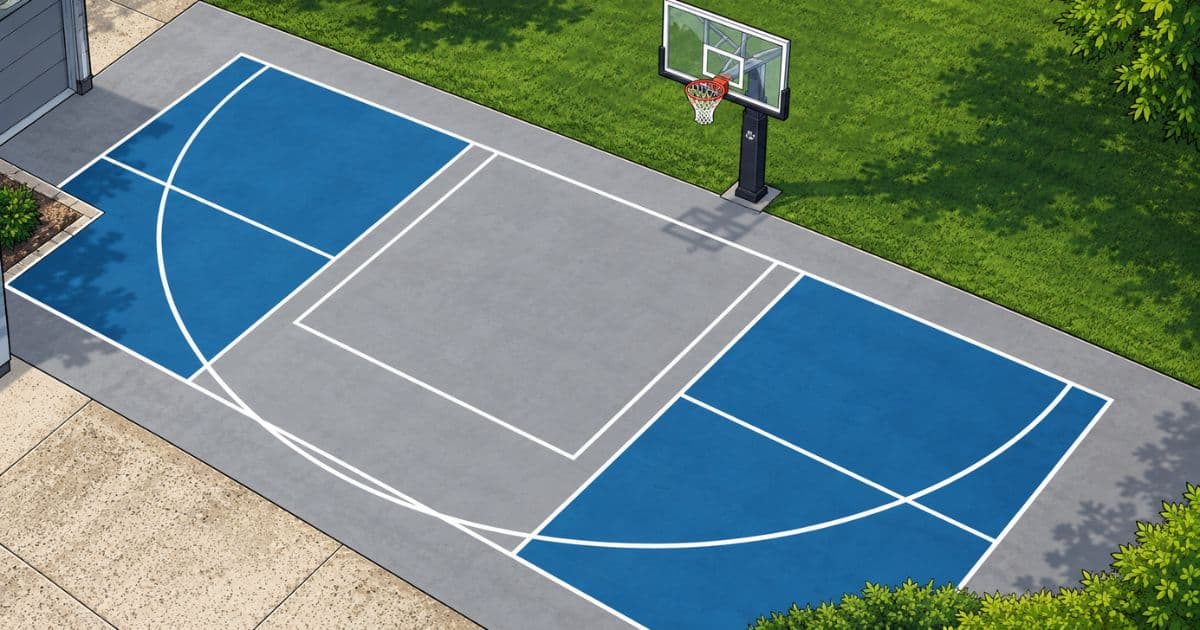
Outdoor blacktop basketball courts at public parks vary in size, and few match the exact footprint of an NBA, college, or high school gym floor. Even so, a full outdoor court or a large half court can host a temporary pickleball setup with a portable net and chalk or tape lines, the same low-cost approach used to convert a home driveway into a pickleball court, covered in the guide to pickleball on a driveway. What matters most is a level surface free of the cracking asphalt develops over time, plus enough clear space beyond the 44-foot baseline for deep shots. Anyone setting up on a shared public court should confirm with the park that pickleball is allowed at that time, since a portable net covering half a basketball court can conflict with a pickup game already in progress.
Do the Pickleball Rules Change When Playing on a Basketball Court?
The rules stay the same regardless of what sport the floor was originally painted for. Under Rule 10.A of the 2026 rulebook, the serve and the return of serve must each bounce once before either side can volley, the two-bounce rule, applying identically on hardwood, asphalt, or a purpose-built outdoor court. Section 11 still calls a fault if a volleying player or anything touching that player contacts the non-volley zone, the seven-foot area on each side of the net defined in Section 3, and Section 13 confirms a ball clipping the net and dropping onto the opponent’s side stays in play. Section 7’s serving rules, an underhand motion with an upward paddle arc and contact no higher than the server’s waist, apply the same way in a gym or on a park court. A basketball floor changes the setup, not the rulebook.
Frequently Asked Questions
Do you need a special net to play pickleball on a basketball court? Yes. Regulation portable nets span 22 feet, one foot wider than the court’s 20-foot sideline-to-sideline distance on each side, and stand 36 inches at the sidelines and 34 inches at the center under the 2026 rulebook. A gym without permanent net posts uses one of these portable models instead.
Can you use basketball court lines for pickleball? No. Basketball lane lines, the three-point arc, and the center circle do not match pickleball’s 20 by 44 foot layout under the 2026 rulebook, so facilities add separate tape or painted lines in a contrasting color rather than reusing the basketball markings.
How many pickleball courts fit on one NBA-sized gym floor? Up to four. Two 20-foot-wide courts fit side by side across the court’s 50-foot width, using 40 of the 50 feet, and two 44-foot courts fit end to end within the 94-foot length, using 88 of the 94 feet.
Does the ball bounce differently on a basketball court than outdoors? It can. A court-surfacing guide from Pace Court describes hardwood as giving a smooth, controlled bounce, while modular sport court tile adds a slightly flexible feel that can vary with tile thickness.
Do the two-bounce rule and non-volley zone still apply indoors? Yes. Rule 10.A of the 2026 rulebook still requires the serve and the return of serve to each bounce once before a volley, and Section 11 of the 2026 rulebook still calls a fault on any volleying player who touches the non-volley zone, regardless of the surface underneath.
Is tape or paint better for a temporary pickleball court on a basketball floor? It depends on how often the space gets used. Tape works for a single event and peels away afterward, while painted dual-striping suits a gym that hosts pickleball on a regular schedule, since it never needs relaying between sessions.
Can a high school gym host two pickleball courts? Yes. An 84 by 50 foot high school court fits two 20-foot-wide pickleball courts side by side, using 40 of the 50 feet, though the 84-foot length only accommodates one 44-foot row rather than two.
Is it allowed to play pickleball on an outdoor asphalt basketball court? Generally yes, provided the facility permits it and the surface is level. Rules vary by park, so checking a court’s posted schedule before setting up a portable net avoids conflicts with a basketball game already booked for that time.
Does a basketball court need a subfloor upgrade for pickleball? Not necessarily. Existing hardwood or synthetic flooring generally works for casual or club-level play, though facilities building a dedicated program sometimes add cushioned subfloor systems for extra joint protection.
Converting a basketball court for pickleball costs little more than a portable net and a roll of tape, which is why so many gyms and parks departments run both sports on the same floor. Anyone planning a session on borrowed gym time can check the guide to finding indoor pickleball courts nearby, since many facilities post an open-play schedule online, and some community centers list sessions through the guide to free pickleball courts that require no membership. For a wider look at local courts, clubs, and open-play times, the public pickleball courts directory covers listings by city and facility type.
Written by the Pickler Junction Team.