
What Is an ATP in Pickleball?
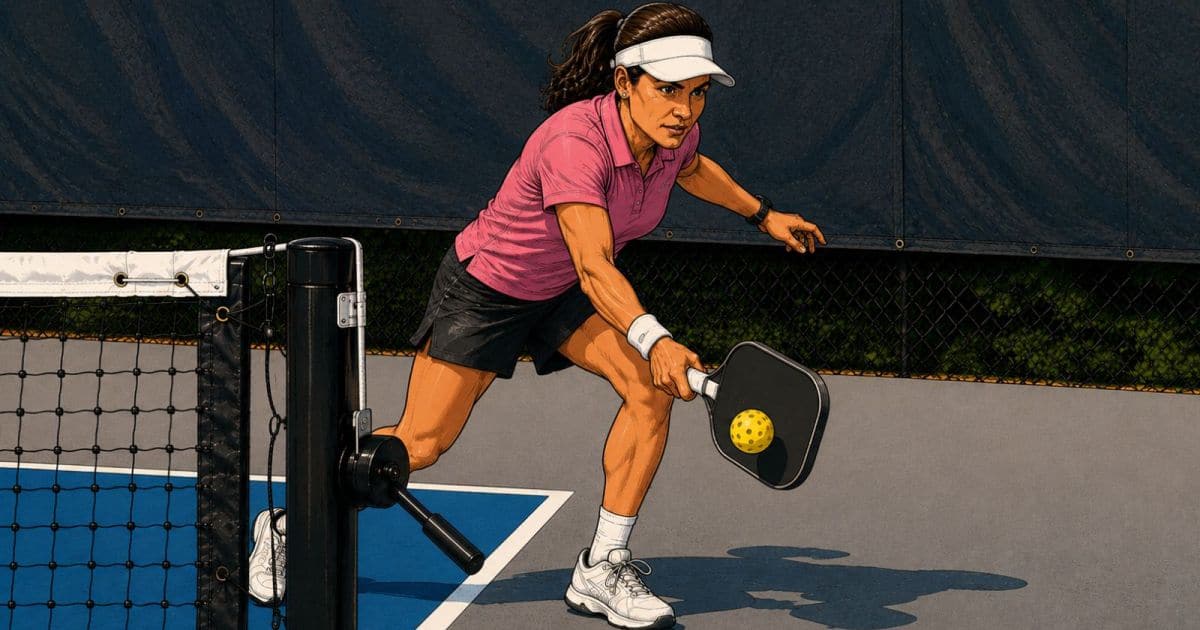
Quick Answer: An ATP, or around-the-post shot, sends the ball around the outside of the net post instead of over the net. Under the 2026 USA Pickleball rulebook, Rule 13.C makes this legal, and it carries no height requirement, so the ball can travel below net level. It only needs to land inbounds in the correct court to count.
The ATP is the shot that makes spectators react. The first time you see one land, it looks like it should not count. It does. Here is what it is, why the rules allow it, and when the chance actually shows up.
What is an around-the-post shot?
An around-the-post shot, or ATP, is a return that travels around the net post instead of over the net. You hit it from well outside the sideline, angling the ball back across into your opponent’s court without it ever crossing above the net.
The shot exists because of geometry, not trickery. When an incoming ball is angled sharply enough, it pulls you so far wide of the court that the shortest path back in runs beside the post rather than over the net. At that point, going around the post is the natural line, not a stunt.
Picture the sideline extended past the net. The post sits close to that line, and once you are standing well outside it, the net itself is no longer between you and the open court. The ball can swing in low and wide, clear the post on the outside, and land fair. Players who have never hit one often assume it takes a huge swing. It usually does not. A firm, flat stroke with the right angle is enough once the geometry lines up.
Is an ATP legal in pickleball?
Yes. Rule 13.C states that a ball may be returned around the outside of the net post. It is a fully legal shot, not a loophole, and it counts like any other return.
The rule has one part that surprises people: there is no height restriction. Because the ball never crosses above the net, the usual expectation about clearing net height does not apply under the rulebook. The ball may pass below the height of the net entirely. You can hit it ankle high if that is the line available to you.
The only requirement is where it lands. The ball must come down in the correct court, the same as any other shot. Around the post and in is a winner. Around the post and wide is just an error with better production value. The rest of the rulebook, including the non-volley zone boundaries in Section 11 and standard fault calls, still applies to everything else happening on the point. The post itself only changes the flight path allowed for this one shot.
When is the ATP actually available?
Less often than players hope. The shot needs a specific setup, and an opponent has to hand it to you.
The conditions:
- A sharply angled incoming ball, usually a crosscourt dink or drive that cuts hard toward the sideline.
- A ball that pulls you wide, typically well past the sideline rather than just outside it.
- A ball low enough that the post is not blocking your swing path.
- A landing angle back into the court, which your wide position creates for you.
The honest read is that you do not go looking for an ATP. Your opponent creates the opening by hitting an angle sharp enough to pull you off the court, and your job is recognizing the moment fast enough to take it. Many players freeze here, torn between chasing the ball and giving up on the point, and that hesitation is often what turns a real ATP chance into a missed one.
The fix for most players learning it is to stop watching the net. The instinct under pressure is to look for a way back over the net, and that instinct is what causes people to miss ATPs that were sitting right there. If the ball has taken you outside the sideline and it is still below net height, look at the post first, not the net.
Doubles teams see more ATP chances than singles players because a partner covering the middle frees the wide player to commit fully to the wide ball rather than worrying about the center of the court. Coaches who run angle drills often build them around this exact gap, feeding sharp crosscourt balls until the wide player starts recognizing the post option on reflex instead of thinking it through mid-point.
How does the ATP compare to other specialty shots?
It sits alongside the other shots that reward court awareness over power. An erne involves jumping around or through the non-volley zone to take a ball early near the sideline, and a bert is the same idea executed across a partner’s side of the court. All three come from reading position rather than hitting harder, and all three exploit space an opponent’s shot accidentally opens up.
The ATP differs in one important way: the erne and the bert are moves a player plans and sets up, while the ATP is almost entirely reactive. A player does not choose an ATP the way they choose to creep toward the sideline before an erne. They recognize it in the half second after the ball is already in the air.
That difference matters for how you practice it. Erne and bert footwork can be drilled on a set pattern, because the player controls the setup. ATP recognition has to be drilled against a live, varying feed, because the whole skill is spotting the window, not executing a rehearsed movement.
If you want to build toward these shots, the foundation is the ordinary ones. Reliable volleys, a controlled speed-up, and clean court movement come first. Specialty shots are what a solid base makes available, not a shortcut past it. Players who chase the ATP before they can consistently keep a rally alive usually end up hitting flashy errors instead of flashy winners.
Frequently asked questions
What does ATP stand for in pickleball? ATP stands for around the post. It describes a shot that travels around the outside of the net post rather than over the net.
Is an ATP legal? Yes. Rule 13.C explicitly allows returning the ball around the outside of the net post, as long as it lands in the correct court.
Does an ATP have to go over the net? No. That is the defining feature of the shot under the rulebook. The ball goes around the post instead, so it never has to clear the net.
Can an ATP travel below net height? Yes. There is no height requirement on an around-the-post shot in the rulebook. The ball can pass well below the top of the net, even close to ankle height.
Does the ball have to land in bounds? Yes. Under the rulebook, the only real requirement is that the ball lands in the correct court. A shot that goes around the post and lands out is simply an error.
How do you set up an ATP? A player generally does not set one up. It becomes available when an opponent’s sharply angled shot pulls a player wide past the sideline with the ball still low. The skill is recognizing it quickly, not engineering it.
Is the ATP worth practicing? It is worth drilling the recognition more than the swing itself. Have a partner feed sharp crosscourt angles so you learn what a genuine ATP opportunity looks and feels like before it happens in a real point.
Why doesn’t the post get in the way of an ATP? Because the shot is only available once a player is standing well outside the sideline, past where the post sits. From that position the post is behind the flight path, not in front of it.
The ATP looks like a trick and is really just good geometry plus fast recognition. Build the fundamentals underneath it, and if you want structured help developing the shots that make an ATP possible, browse the coaches directory.
Written by the Pickler Junction Team.