Do You Need Pickleball Shoes with Arch Support?
Quick Answer: You need pickleball shoes with arch support only if your feet already say so: aching arches after play, known flat feet, high arches that tire fast, or heel pain that will not quit. Pain free feet do fine in standard court shoes. Fit and lateral stability matter first. Support usually starts with an insert, not a new pair of shoes.
Arch support is a real feature and an oversold one. This guide stays short on the medical side and points to deeper resources where they belong.
Does everyone need arch support for pickleball?
No. Players with no foot pain and no known arch problems do well in standard court shoes. Most already include a moderate, contoured footbed. The American Podiatric Medical Association says athletic shoes should match a foot’s arch type, whether high, medium, or low, and that a podiatrist can measure feet to confirm which type applies. Adding aggressive support to a foot that never asked for it can create discomfort instead of solving it.
The players who benefit are the ones with a clear signal. Arches that ache during or after sessions. Known flat feet or high arches. A history of arch or heel trouble in other sports. Fatigue that shows up in the feet before it reaches the legs. Court movement loads the foot side to side and does it over and over, which a walk or a jog does not.
If none of that describes your feet, the better use of your time is the guide to what shoes to wear for pickleball. Lateral stability and fit decide court performance for every player, supported arches or not.
How do you know if your arches need help?
Feet report problems in a few recognizable ways.
- Arch or heel ache during or after play, especially in the first steps after sitting down post session.
- Fatigue that arrives early, a pattern that often traces back to arches working overtime.
- Shoes that wear unevenly, collapsing inward at the heel or rolling outward.
- A history of complaints, since arches that have bothered you in other sports usually bother you here too.
One sign deserves its own paragraph. Sharp heel pain that is worst with the first steps in the morning is not a shoe shopping problem. It points toward plantar fasciitis, a condition that affects roughly 2 million patients a year in the United States, according to the American Academy of Orthopaedic Surgeons’ OrthoInfo. More than 90 percent of patients improve within 10 months of starting simple treatment, the same source reports, and that treatment usually means cushioned shoes, heel pads, and sometimes an orthotic rather than a diagnosis made alone. The guide to pickleball shoes for plantar fasciitis covers the condition at the depth it needs. This article does not.
Should you buy supportive shoes or add insoles?
Try an insole first in most cases. It costs less, and it comes back out if it does not help.
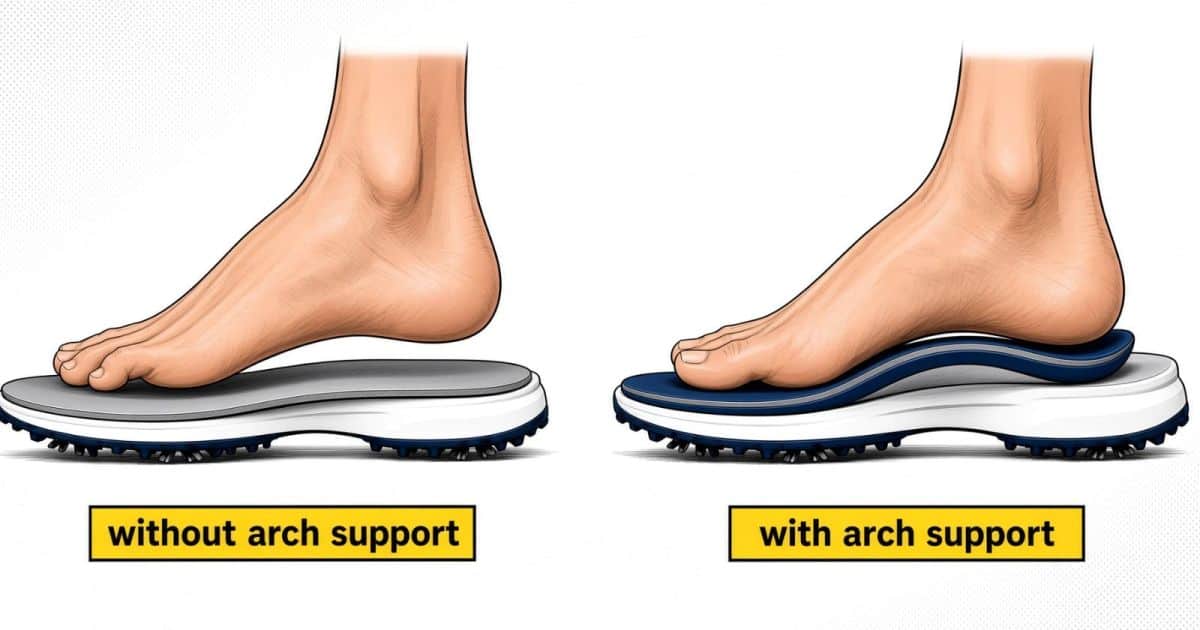
Nearly all court shoes ship with a removable, fairly neutral stock insole, which means support is modular. Pull the flat liner, drop in a supportive insert, and a standard shoe becomes a supported one without losing the lateral stability you bought it for. The American Podiatric Medical Association draws a clear line between the two options. Over the counter inserts are non-prescription foot support, while custom orthotics are made to match the contours of one person’s feet after a podiatrist evaluates how that person’s feet, ankles, and legs move. Inserts cannot correct a biomechanical problem, the association notes, but a healthy foot with mild fatigue often responds to one anyway. The guide to insoles for pickleball covers which inserts to try first.
Buying shoes with built in support beyond that makes sense once an insert has proven the idea works, or when a foot clearly needs a wider, more structured base. The buying checklist stays the same as for any court shoe: lateral stability, heel lockdown, an outsole suited to the surface, then support. A supportive shoe that fits badly still loses to a neutral shoe that fits well.
When is this a doctor question instead of a gear question?
See a professional when pain is sharp, one sided, getting worse, or changing how a player walks. Gear solves gear sized problems, not medical ones.
Reasonable to manage without help: mild ache after long sessions, tired arches, flat feet lived with for years without trouble. Reasonable to hand to a podiatrist: pain that has not improved after a few weeks of better shoes and an insert, morning heel pain that keeps returning, numbness, or tingling. The American Podiatric Medical Association recommends scheduling an appointment with a podiatrist for serious pain or discomfort, since custom orthotics are made only after a full evaluation of the feet, ankles, and legs.
The distinction matters because playing through foot pain changes how a person moves. Changed movement sends stress up the chain to the knees and hips. Feet carry the rest of the body’s load, so fixing the source beats working around it.
FAQ
Do you need arch support for pickleball? Only if your feet signal it: aches, known flat feet, high arches, or fast foot fatigue. Players without pain do fine in standard court shoes.
Do flat feet need special pickleball shoes? Often a supportive insert in a standard court shoe is enough. Shoes with built in support are the next step once an insert proves the idea helps.
What is the fastest way to test if support would help? A moderate, off the shelf insert worn in current court shoes for a few weeks. It costs little, and it can be removed if it does not help.
Is arch pain the same as plantar fasciitis? No. General arch ache is usually a load and support issue. Sharp heel pain that is worst with the first steps of the day points toward plantar fasciitis, a condition the American Academy of Orthopaedic Surgeons says affects about 2 million patients a year in the United States.
Do supportive shoes hurt performance? Not when they fit well. Lateral stability and heel lockdown still decide how a shoe performs on court. Arch support changes interior geometry, not speed.
Can high arches cause problems too? Yes, mainly shock absorption and loading on the outer foot. The American Podiatric Medical Association notes that athletic shoes should match a foot’s arch type, whether high, medium, or low.
Should someone wear walking shoes with arch support instead of court shoes? No. Support does not replace lateral stability. Whatever the arches need, the shoe still has to be built for lateral, stop and start court movement.
When should someone see a professional about their feet? See a podiatrist for pain that is sharp, persistent, or worsening, for morning heel pain that keeps returning, or for anything unchanged after weeks of better shoes and an insert. The American Podiatric Medical Association recommends an evaluation whenever pain is serious enough to interfere with normal activity.
Most of these questions come down to listening to a specific signal instead of guessing. When the signal points to hands on help, the pickleball gear and accessories directory lists pro shops and fitters who can measure feet, fit court shoes, and stock inserts on the spot. This article is general information, not medical advice.
Written by the Pickler Junction Team.