Do Insoles Help for Pickleball?
Quick Answer: Insoles for pickleball help a specific group: players whose feet ache or tire during sessions, who need more support than their court shoes provide, or who want better shock absorption on hard courts. For pain free feet they are optional. They upgrade a good shoe and cannot rescue a wrong one.
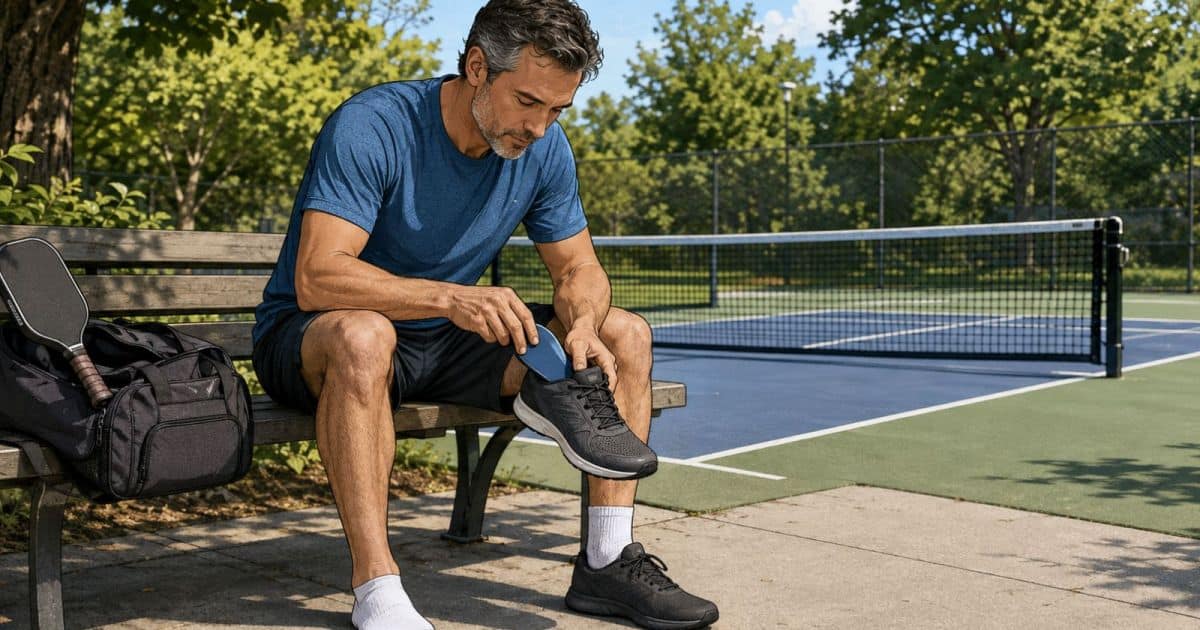
An insole is the removable footbed inside your shoe, and the aftermarket version is a straightforward proposition: better geometry and materials under your foot, dropped into shoes you already own.
What can an insole actually fix?
Comfort, support, and shock absorption, which covers a lot of the complaints hard courts generate. The honest list:
- Foot fatigue, the tired achy feeling after long sessions, which better support spreads across more of the foot.
- Mild arch complaints, by filling the gap between a flat stock footbed and what your arch wants. The fuller decision framework is in our guide to pickleball shoes with arch support.
- Hard court harshness, since every stop and lunge lands on concrete backed acrylic, and a cushioned insert takes the edge off repeated impact.
- Fit fine tuning, taking up a little excess volume in a shoe that is marginally roomy.
- Worn stock footbeds, which flatten long before the shoe’s structure dies.
What an insole cannot fix is the shoe around it. No insert adds lateral stability, revives dead cushioning, or converts a running shoe into a court shoe. If the shoe itself is the problem, the answer lives in our guide to what shoes to wear for pickleball, and the insert money waits until the shoe is right.
What kind of insole should you try first?
An off the shelf sport insert with moderate support, matched roughly to your arch height. That one sentence is most of the buying advice.
The market splits into cushioning inserts, soft, plush, minimal structure, and support inserts, firmer with a shaped arch and heel cup, with sport versions blending both. Players chasing comfort on hard courts want the blend. Players with arch signals want the structured kind, in the arch height that matches their foot. Trim to fit with the stock insole as the template, and give the foot a week or two of sessions to adapt before judging: structured inserts feel present at first in a way that fades as the foot settles.
Two practical cautions. First, an insert changes shoe volume, so extremely cushioned shoes plus thick inserts can crowd the foot; the combination has to fit as a system. Second, more support is not better support: the firmest orthopedic style insert a store sells is a tool for specific feet, not a performance ladder to climb.
A mid height sport insert bought for one reason, hard court fatigue, typically returns about a game’s worth of fresher feet per session, which for the price of a tub of balls is one of the best ratios in the bag.
When are insoles the wrong answer?
When the problem is pain rather than tiredness, and especially when the pain has a pattern.
Sharp heel pain that is worst on the first steps of the morning is the signature of plantar fasciitis, and that condition deserves its own playbook, not a drugstore insert and hope. Our dedicated guide to playing pickleball with plantar fasciitis is the deep resource, and this article intentionally stays out of its territory. The same referral applies to numbness, tingling, pain that alters your walk, or anything persistent and worsening: that is podiatrist material, and custom orthotics prescribed for your actual foot exist precisely for the cases off the shelf inserts cannot serve.
The rule that keeps this simple: inserts are for comfort and support, professionals are for pain. Players who ask an insert to do a clinician’s job usually spend months and several products learning the distinction.
How do you know if the insole is working?
Your feet answer within about 2 weeks of normal play, and the answer shows up in three places: sessions end with less foot fatigue, the specific ache that sent you shopping quiets, and you stop thinking about your feet mid game, which is the actual goal.
Keep the experiment clean: change the insert, not the socks and shoes at the same time, and judge on your usual sessions rather than one long tournament day. If the insert is a wash after two fair weeks, pull it and bank the finding, since a foot that rejects support is information too.
Replace inserts when they flatten or the shaping visibly compresses, which for regular players is typically well inside the life of two shoe cycles. And when the shoes themselves are replaced, move the insert only if it still has structure; a dead insert in a new shoe is a downgrade wearing an upgrade’s receipt.
FAQ
Do insoles help for pickleball? They help players with foot fatigue, mild arch complaints, or hard court soreness. Pain free players can skip them without missing anything.
Whats the difference between insoles and orthotics? Insoles are off the shelf inserts. Orthotics are custom devices prescribed and made for your specific foot, for problems inserts cannot handle.
Will insoles fix heel pain? Not the recurring sharp kind, which points at plantar fasciitis and needs its own approach. Inserts handle comfort and support, not conditions.
Can insoles make a running shoe okay for pickleball? No. Lateral stability comes from the shoe’s structure. The insert only improves what is under the foot, never what is around it.
How do I pick my first insert? A sport insert with moderate structure, matched to your arch height, trimmed using the stock insole as a template, and tested for two weeks of normal play.
Do insoles change shoe fit? Yes, slightly, since they occupy volume. The shoe and insert have to fit together, which is a reason to test rather than assume.
How long do insoles last? Until they flatten or lose shape, typically faster than shoes for frequent players. A compressed insert is doing nothing but taking up space.
Are expensive insoles worth it? Mid priced sport inserts serve most players. The premium tier earns its cost mainly for specific feet with specific demands, ideally identified with professional input.
Want to try before committing? The pro shops and retailers in our directory stock inserts alongside the shoes they go into, and the wider kit lives in our gear and accessories listings.
Written by the Pickler Junction Team.