
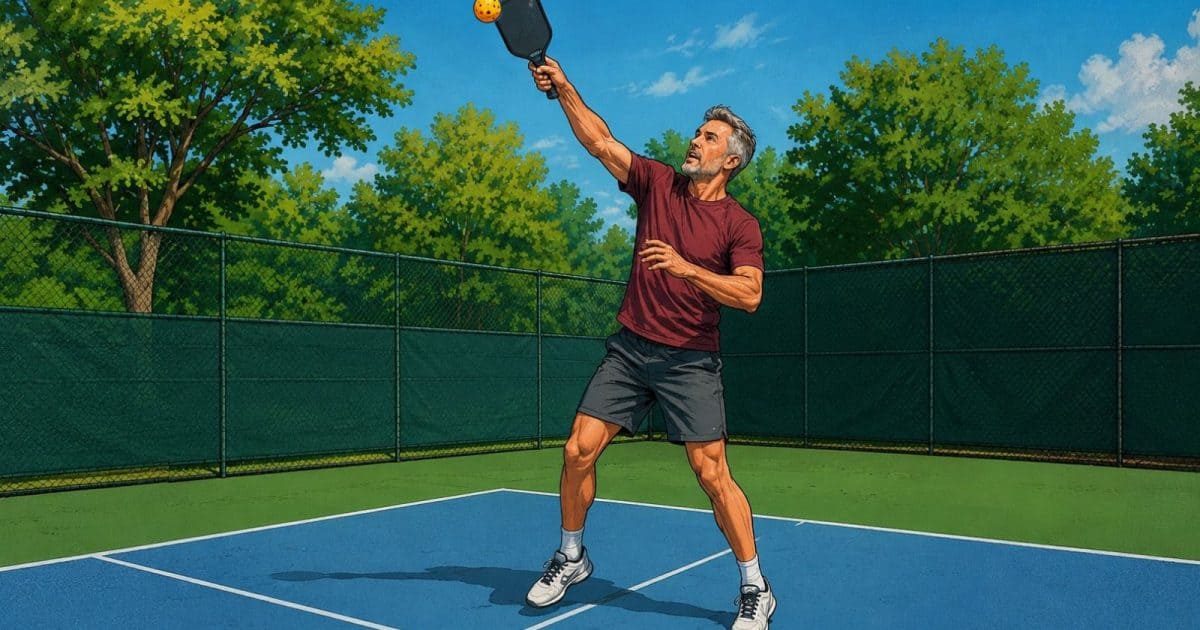
Can You Spike in Pickleball?
Quick Answer: Yes, you can spike in pickleball. Overhead smashes are completely legal as long as you follow two rules: you can’t volley while touching the non-volley zone or its line, and you can’t smash the serve or the return before they bounce. Position and timing make a spike legal, never the swing itself.
So, can you spike in pickleball? Yes, with one big catch. A spike, usually called a smash or overhead in pickleball, is a hard downward shot hit above shoulder height, and nothing in the rulebook restricts how hard or how steeply you can hit the ball. The restrictions are all about where your feet are and when the ball arrives.
When Is Spiking Legal?
Spiking is legal in two situations. First, any ball you take out of the air while standing completely outside the kitchen and off its line can be smashed as hard as you like. Second, any ball that has bounced can be smashed from anywhere on the court, including from inside the kitchen itself. That second one surprises newer players. If your opponent pops up a dink and it bounces high inside the non-volley zone, you may step in and hammer it downward, because the no-volley restriction only applies to balls hit out of the air.
The classic legal spike is the put-away off a pop-up: your opponent floats a ball above net height, you’re stationed just behind the kitchen line, and you swing down through it. That shot ends more rallies than any other in the sport.
When Is a Spike a Fault?
Three situations turn a beautiful smash into your opponent’s point:
- Kitchen violations. You volley while any part of your body, paddle, or clothing touches the 7 foot non-volley zone or its line.
- Momentum violations. You smash from behind the line, but your follow-through carries you into the kitchen. Still a fault, even if the ball was already dead.
- Two-bounce violations. You smash the serve or the return of serve out of the air. Both must bounce first.
The momentum rule deserves respect. Big overheads generate big forward momentum, and referees and honest opponents watch your feet after the swing, sometimes for two or three steps. If you can’t stop yourself outside the zone, the smash was a fault no matter how clean the contact felt. I’ve donated more than one rally to gravity this way, and the lesson stuck: set your feet before you swing, or let the ball bounce.
How Is Spiking Different from Volleyball or Tennis?
The swing is the same idea, but the geography is unique to pickleball. Volleyball players can attack from anywhere behind the ten foot line and land wherever momentum takes them. Tennis players smash from any spot on the court. Pickleball puts a 7 foot forbidden strip on each side of the net exactly where spiking would be most lethal, which is the entire point. The kitchen exists so the game can’t collapse into net-crashing smash contests, and it’s why touch shots like the reset and the dink matter as much as power.
There’s also a net-height wrinkle. The pickleball net stands 34 inches at center, low enough that a ball only slightly above net height can be attacked. That’s why keeping your shots low is defense, and why anything that floats gets buried.
How Do You Defend Against a Spike?
Three answers, in order of usefulness. First, don’t feed it: keep dinks and drops low so there’s nothing to smash. Second, back up: when an opponent lines up an overhead, retreating a few steps buys reaction time and turns their kill shot into something you can block. Third, learn the reset, absorbing the smash with a soft paddle and dropping it into their kitchen. Skilled aggressive net players, including partners who love to poach, feast on high balls, so the real defense starts with your shot selection two shots earlier.
If your overhead needs work, or your defense against one does, drilling with a coach beats guessing. Plenty of clinics and instructors in the directory run put-away and reset sessions.
FAQ
Can you smash from inside the kitchen?
Yes, if the ball has bounced. The non-volley zone only prohibits volleys. A ball that bounces high inside the kitchen may be smashed by a player standing in it.
Can you jump and spike in pickleball?
Yes, as long as you don’t touch the kitchen or its line during the act of volleying, including your landing and follow-through. Jumping from outside the zone and landing outside it is legal.
Is there a rule against hitting the ball too hard?
No. There’s no speed limit in pickleball. Power is regulated indirectly through the kitchen, the two-bounce rule, and the underhand serve.
Can you spike the serve return?
No. The two-bounce rule requires the serve and the return of serve to bounce before anyone volleys. Smashing the return out of the air is a fault.
What happens if my momentum carries me into the kitchen after a smash?
It’s a fault, and the rally goes to your opponents. The rule applies even if the ball bounced twice or was declared dead before you touched the zone.
Is it legal to smash directly at an opponent?
Yes. Body shots are legal and common in competitive play, and a ball that hits an opponent is a fault against them. Rec etiquette says aim for feet, since headhunting wins points and loses friends.
Why is the kitchen 7 feet deep?
The 7 foot depth on each side was built into the sport’s original design to keep players from smashing at the net, forcing the soft game that makes pickleball distinct.
Written by the Pickler Junction Team.