Why Pickleball Makes You Happy: What the Science Says
Quick Answer: Pickleball supports better mood by combining exercise, skill-based competition, and social contact in one session. A 2023 systematic review in Frontiers in Psychology, covering 13 studies on pickleball players, most older than 50, found consistent improvements in wellbeing, life satisfaction, and happiness, along with reductions in stress and depression symptoms.
Pickleball has a reputation for making people happy. That reputation is not just talk at the courts. A small but growing body of published research has looked directly at pickleball and mood, and the pattern holds up. Here is what the evidence actually shows.
Does Pickleball Really Make You Happier?
Yes. A 2023 systematic review in Frontiers in Psychology, by researchers Cerezuela, Lirola, and Cangas, screened 63 papers on pickleball and mental health and included 13 studies that met their criteria. About 91 percent of the participants across those studies were older than 50. The review reported consistent improvements in personal wellbeing, life satisfaction, and happiness, along with reductions in stress and depression symptoms among pickleball players. The authors described pickleball as an inclusive sport that does not require special adaptations for most adults, which is part of why it shows up so often in wellbeing research focused on older players. The mood benefits were not limited to strong competitors. Regardless of where someone lands on the pickleball skill levels scale, the review found the same direction of effect: better mood scores among regular players.
What Happens in Your Brain When You Play?
Pickleball activates several mood-related systems in the brain at once, which is different from a solo treadmill session.
- Endorphins from sustained aerobic movement. This is the classic exercise mood lift, and it also blunts the short-term perception of pain and stress.
- Dopamine every time you win a point or finally land a third shot drop. This is the brain’s reward chemical, released for skill and achievement, not only for movement.
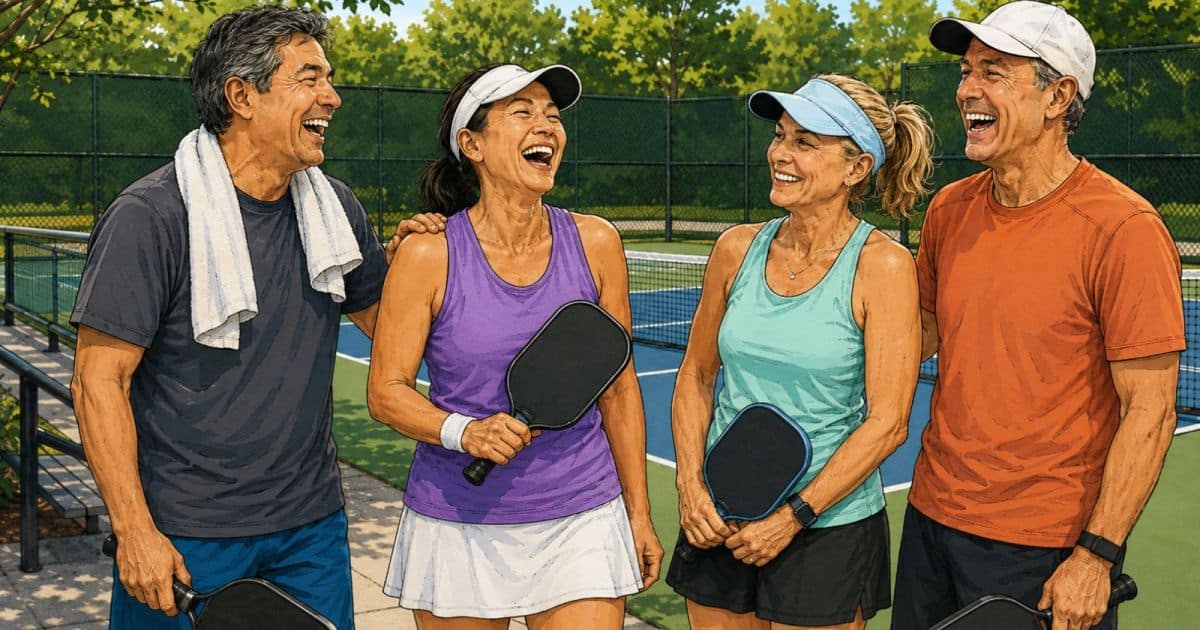
- Oxytocin from the social contact: laughing between points, paddle taps at the net, banter while waiting for a court. This bonding chemical does not fire the same way during a solo walk.
- Lower cortisol over time. Regular physical activity is associated with reduced levels of this stress hormone.
No single ingredient explains the lift on its own. Movement, skill-based reward, and social contact happening together in the same hour is what sets pickleball apart from exercise alone.
Why the Social Side Is the Secret Weapon
Loneliness is a well-documented risk factor for poor mental health. The National Institute on Aging links social isolation and loneliness to higher risks of depression, anxiety, and cognitive decline, and it recommends staying physically active with others as one way to build supportive connections. Pickleball is built for exactly that. Open play puts you on a court with strangers who quickly become regulars. Games are short and rotation is constant, so waiting for the next game practically forces conversation.
The social layer extends off the court, too. Many clubs and courts host a pickleball happy hour, a casual mixed-level social session built around meeting people as much as playing points, and that lower-pressure format is often where new players form the connections that keep them coming back. More people are building that kind of community every year. The Sports & Fitness Industry Association counted 24.3 million pickleball players in the US in 2025, up from 4.2 million in 2020, participation figures current as of September 2026. Arriving at open play knowing nobody and leaving with a group text thread going is an ordinary outcome. The sport does the introductions for you.
How Much Do You Need to Play to Feel It?
No published pickleball-specific study has pinned down an exact number of weekly sessions needed for a mood lift. What the CDC does confirm is that even a single session of physical activity can reduce short-term feelings of anxiety in adults, and pickleball qualifies as moderate to vigorous aerobic activity for most players. In practice, consistency matters more than chasing one perfect number. Getting on the court two or three times a week is a reasonable target for most players, and it does not have to be expensive. A drop-in game at a municipal court typically runs $2 to $6 per session, and group clinics for building skill run about $20 to $50 per person, both well below the cost of many recurring hobbies.
One honest caveat: the mood benefits depend on actually being able to play. An injury sidelines the exercise, the competition, and the social contact all at once, which is a good argument for a proper warm-up routine and some off-court strength work to stay on the court instead of the bench.
Is Pickleball Better for Your Mood Than Walking or the Gym?
The honest answer is that pickleball combines ingredients that solo cardio usually does not, though few controlled studies compare pickleball head to head against walking or gym workouts on mood specifically. Walking delivers the endorphins from aerobic movement, but not the dopamine of competition or the social contact of a doubles match. The mood benefits documented in the Frontiers in Psychology review came from a sport that combines movement, hand-eye skill, and social contact in the same session, three ingredients a solo walk or a machine at the gym usually deliver separately, if at all. Is pickleball good exercise covers the cardio and calorie side in detail. On the mood side, the social structure of the sport looks like the main advantage over solo exercise, based on the pattern across the studies in the review rather than a head-to-head trial.
FAQ
Does pickleball help with depression and anxiety? Research specific to pickleball is still limited, but the 2023 Frontiers in Psychology review found consistent reductions in depression and stress symptoms across the 13 studies it covered. It can be a meaningful complement to care, not a replacement for treatment when professional support is needed.
Why do I feel so good after playing pickleball? The likely combination is exercise endorphins, the reward of competition, and social contact, though no single study has measured all three together in one session. Each piece is well established in exercise science on its own.
Is pickleball good for mental health in older adults? Especially so. About 91 percent of the participants in the 2023 Frontiers in Psychology review were older than 50, and that is also where the strongest findings on wellbeing and life satisfaction appear.
How often should I play pickleball for mood benefits? No pickleball-specific study has set an exact number, but two to three sessions a week is a reasonable, sustainable target, and the CDC notes that even one session of physical activity can lift short-term mood.
Does pickleball help kids’ mental health too? Published research so far has focused mostly on adults, especially players older than 50. Less has been published specifically on children and teenagers, though the same exercise and social-connection mechanisms would reasonably apply.
Can pickleball replace therapy or medication? No. It is a strong mood support with real evidence behind it, but anyone dealing with ongoing depression or anxiety should work with a licensed professional.
What if pickleball leaves me more stressed than happy? That usually points to overplaying through an injury, or too much competitive pressure and not enough of the social side. Scaling back intensity and adding a proper warm-up routine often restores the balance.
The happiest pickleball players tend to be the ones who show up consistently, not necessarily the ones who win the most. If low mood or anxiety is a bigger issue than a hobby can address, a licensed professional is the right first stop, and a pickleball coach from the Pickler Junction directory is a reasonable next stop for building the skill and consistency that make the sport worth returning to. This article is general information, not medical advice.
Written by the Pickler Junction Team.