What Is a Volley in Pickleball?
Quick Answer: A volley in pickleball is any shot hit out of the air before the ball bounces. Volleys are legal everywhere on the court except the non-volley zone, the 7 foot kitchen at the net. They’re the fastest shots in the game and the reason positioning at the kitchen line wins points.
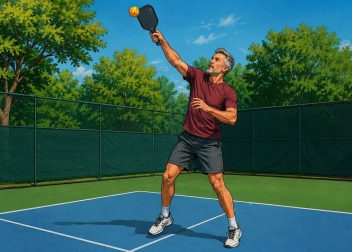
A volley is defined as striking the ball before it touches the ground. That’s the entire definition, and it covers everything from a blistering putaway to a gentle block that barely moves. If the ball hasn’t bounced when your paddle meets it, you volleyed.
What Makes a Volley Different from a Groundstroke?
Time. A groundstroke is any shot hit after the bounce, which gives you the bounce itself as a timing cue and a beat to set your feet. A volley removes that beat. The ball arrives on the fly, often from 14 feet away across two kitchens, and you respond on reflex. That compression of time is why volleys dominate at the kitchen line: taking the ball out of the air steals reaction time from your opponent and keeps them from advancing.
Mechanically, good volleys are short. A compact punch or block, paddle up in front of your chest, beats a full swing nearly every time. Players who take backswings at the kitchen line arrive late to fast exchanges, which any experienced opponent will happily exploit.
Where Can You Legally Volley?
Everywhere except the kitchen. The non-volley zone extends 7 feet from the net on each side, and you may never volley while any part of your body, paddle, or clothing touches that zone or its lines. Momentum counts too: if your volley carries you into the kitchen afterward, it’s a fault. The zone restricts the act of volleying only. You may stand in the kitchen freely and hit any ball that has bounced.
There’s also a when restriction. The two-bounce rule requires the serve and the return of serve to bounce before anyone volleys. The first legal volley of any rally is the third shot at the earliest, and volleying either of those first two balls is a fault regardless of where you stand.
Why Are Volleys So Important?
Because pickleball is won at the kitchen line, and the volley is the shot you hit there. Once both teams reach the line, points turn into exchanges of dinks and volleys separated by inches of net clearance. The team that can volley aggressively without faulting controls those exchanges. A few numbers frame it: the net is 34 inches at center, the kitchen line sits 7 feet back, and two players at their respective lines stand only 14 feet apart. At that distance a firm volley arrives in a fraction of a second.
Volleys come in flavors worth knowing:
- Punch volley: the standard firm putback, hit with a short forward jab.
- Block volley: a soft-hands absorption of a hard drive, dropping the ball back short.
- Roll volley: a low-to-high brush adding topspin, used to attack from below net height.
- Drop volley: a delicate touch shot that dies in the opposing kitchen, close cousin of the reset.
- Overhead: the smash, technically a volley when the ball hasn’t bounced.
My own game changed the day a partner pointed out I was swinging at volleys like groundstrokes. Shortening to a punch fixed a season of netted balls in one afternoon.
How Do You Improve Your Volleys?
Start with ready position: paddle up, in front of your body, at chest height, every second you’re at the line. Most missed volleys are lost before the swing because the paddle started at the hip. Then drill fast hands. Two players at opposing kitchen lines volleying directly at each other, cooperative then competitive, is the single highest-value drill in the sport. Aggressive net players, especially those who love to poach, are simply players who won that drill more often.
Games like skinny singles sharpen volleys under real pressure, and structured work with local instructors and clinics will clean up mechanics faster than YouTube ever will.
FAQ
Can you volley a serve?
No. The two-bounce rule requires the receiving team to let the serve bounce. Volleying the serve is a fault and gives the serving team a point.
Can you volley while standing in the kitchen?
No, never. Volleying while touching the non-volley zone or its lines is a fault, no matter how high the ball is or how gently you hit it.
Is a smash considered a volley?
If the ball hasn’t bounced, yes. An overhead hit out of the air is legally a volley and subject to all kitchen restrictions, including the momentum rule.
Can your paddle cross the kitchen line during a volley?
Yes. Your paddle may break the plane of the kitchen in the air during a volley, as long as nothing touches the zone itself, the line, or anything in it.
What is a half volley?
A half volley is hit immediately after the bounce, on the short hop. Because the ball bounced, it’s legally a groundstroke and can be hit from inside the kitchen.
Why can’t you volley in the kitchen?
The rule prevents players from standing at the net and smashing everything downward. It forces the soft game of dinks and drops that defines pickleball.
Should beginners volley more or let balls bounce?
Let borderline balls bounce early on, since rushed volleys produce errors. As your hands improve, take more balls out of the air to pressure opponents and hold the kitchen line.
Written by the Pickler Junction Team.