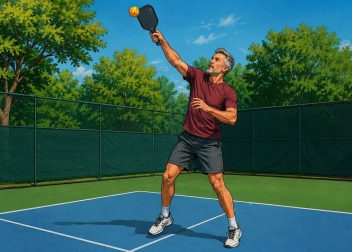
What Is a Reset in Pickleball?
Quick Answer: A reset in pickleball is a soft, defensive shot that neutralizes an opponent’s attack by dropping the ball gently into their kitchen. Instead of counterattacking a hard drive or smash, you absorb its pace and land the ball where it can’t be attacked, restarting the point on even terms.
A reset is a defensive shot that takes the speed off an aggressive ball and returns it softly into the non-volley zone, unattackable. The name says it all. Your opponents built an advantage, and one good reset wipes the ledger and starts the rally over.
Why Does the Reset Matter So Much?
Because pickleball rewards patience, and the reset is patience with a paddle in its hand. When opponents speed the ball up, the instinctive response is to swing back harder, and that instinct loses. Firefights favor whoever attacked first from the better position. The reset offers the counterintuitive alternative: decline the fight. A ball dropped softly into the kitchen must bounce before your opponents can play it, and a ball played off a low bounce inside the kitchen cannot be smashed effectively. Their attack dies, everyone returns to neutral, and the point restarts as a soft game, which is exactly where disciplined teams want to live.
Watch any high-level match and count. Attacks are frequent, but clean winners off the first speedup are rare precisely because good players reset so well. The team that resets twice under fire usually gets the next attackable ball themselves.
How Do You Hit a Reset?
Soft hands, short motion, and a grip pressure change do nearly all the work. The mechanics:
- Loosen your grip to roughly a 3 out of 10. A tight grip rebounds pace right back and sails the ball long.
- Get low, knees bent, paddle out in front below the ball’s flight.
- Block, don’t swing. Let the incoming pace hit a relaxed paddle face, like catching an egg.
- Open the face slightly and aim for a landing spot inside the kitchen, netting the ball on an arc that peaks on your side.
- Recover to ready position immediately, because one reset often invites another attack.
The whole art is absorption. The harder they hit, the less you do. My first coach put it as “your paddle is a pillow, and stop apologizing to the pillow,” and the phrase stuck better than any biomechanics lecture.
When Should You Reset Instead of Attack?
Reset whenever the ball reaches you below net height, whenever you’re stretched or off balance, and whenever you’re caught in the transition zone, the awkward midcourt real estate between baseline and kitchen line. Balls below the net’s 34 inch center height cannot be attacked downward, so hitting them hard means hitting them up, which hands your opponents the next smash. Reset those. Attack only when the ball is above net height and you’re balanced.
The transition zone deserves its own sentence, because it’s where resets earn a living. After a return of serve, you have roughly 15 feet of vulnerable court to cross while opponents at the kitchen line volley at your feet. Nobody sprints through that against good opposition. You advance one reset at a time: absorb a volley, drop it in their kitchen, take two steps, repeat until you’ve earned the line.
How Do You Practice Resets?
The standard drill needs one partner and half a court. You stand in the transition zone, your partner stands at the kitchen line and feeds firm volleys at your feet and hips. Your only job is dropping every ball softly into their kitchen. Score it, ten feeds per turn, and switch. Playing games of skinny singles layers the same skill into live competition, since half-court play produces constant speedups you must defuse alone. And any fault-free firefight defense starts here, because desperate players commit kitchen violations that calm players never do.
Groups and instructors run reset ladders and transition drills constantly, and if you’d rather suffer in good company, clubs and clinics near you make this exact skill a staple session.
FAQ
What’s the difference between a reset and a dink?
A dink is an offensive-neutral soft shot exchanged when both teams are already at the kitchen. A reset is defensive, hit under attack to take pace off a fast ball and return the rally to neutral.
What’s the difference between a reset and a drop?
A drop, usually the third shot, is hit off a bounce from the backcourt to enable your approach. A reset is typically hit off a hard-driven ball, often out of the air, purely to survive an attack. Same landing zone, different circumstances.
Where should a reset land?
In the opponent’s kitchen, ideally near the middle or at the feet of the closest attacker, low enough that the ball cannot be volleyed downward.
Should a reset be hit out of the air or off the bounce?
Both happen constantly. In the transition zone you’ll block many resets out of the air. When you have time, letting the ball bounce and drop lower makes the reset easier.
Why do my resets keep popping up?
Grip pressure, almost every time. A tight grip and any forward swing add energy to a ball that already has plenty. Loosen the hand, shorten the motion, and let the pace die on the paddle.
Is the reset an advanced skill?
The concept is beginner-friendly and the touch takes years to master. Players usually consider reliable resets the dividing line between intermediate and advanced play.
Can you reset a smash?
Yes, and it’s one of the most satisfying shots in the sport. Back up to buy reaction time, get the paddle out front, and block the smash softly into the kitchen.
Written by the Pickler Junction Team.