Do You Need a Rating to Play Pickleball?
Quick Answer: No. You can play open play, join most clubs, and take lessons without any rating at all. A rating becomes useful when you want to play in a level-sorted session, a league, or a tournament, because organizers need a way to group players. For those, you can self-rate against USA Pickleball’s skill descriptions for free, or build a number through a rating system such as DUPR or UTR-P by logging match results.
New players hear “what’s your rating” within the first week and assume there is a test to pass or a card to carry. There is not. A rating is a convenience for sorting players into fair games, and for most of what you will do in your first year of pickleball, nobody will ask for one.
Here is when you need one, when you do not, and how to get one when the time comes.
When Do You Not Need a Rating?
Open play at a public court asks for nothing. You put your paddle in the line and play whoever comes up. The guide to what open play is covers how that works.
Lessons and clinics do not need one either. A coach will figure out your level in ten minutes, and a beginner clinic assumes you have none. The guide to what to expect at a beginner clinic covers it.
Most clubs will take a new member without a rating. They may ask you to self-rate so they know which sessions to point you toward, and some run a short skills assessment, but that is placement, not a gate. The guide to what happens at a skills assessment covers what that looks like.
When Does a Rating Start to Matter?
The moment players are being sorted.
Level-sorted open play, the kind posted as “3.0 to 3.5,” needs you to know roughly where you fall so you pick the right session. Self-rating is enough for that.
Leagues almost always sort by level, and many now use a rating system to do it so that one player’s “I’m a 3.5” means the same thing as another’s. The guide to how pickleball leagues work covers how they are organized.
Tournaments sort by skill bracket as well as age. Entering a 3.0 bracket as a 4.0 is called sandbagging and is the fastest way to be disliked in a sport that is otherwise very friendly. Tournament directors increasingly check entries against a rating system for exactly that reason. The guide to how to sign up for a pickleball tournament covers what entry asks for.
What Is a Self-Rating?
USA Pickleball publishes skill level definitions from 1.0 to 5.5 in half-point steps, describing what a player at each level can do with the forehand, backhand, serve, dink, third shot, volley, and strategy. You read them, pick the level that matches your ordinary game, and that is your self-rating.
It costs nothing and takes ten minutes. It is also the rating most recreational players use for years. The guide to pickleball skill levels covers what each level means, and how to self-rate your skill level covers doing it honestly, which is the hard part. The standing advice: when torn between two levels, rate down.
What Is a Rated Number, and How Do You Get One?
A rating system turns match results into a number that moves as you win and lose against rated players. Two systems cover nearly all recreational pickleball.
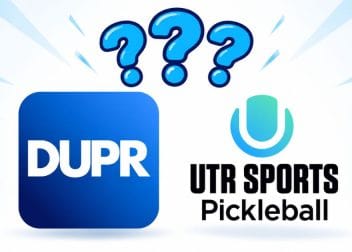
DUPR rates every player on the same 2.000 to 8.000 scale regardless of age or gender, keeps separate singles and doubles ratings, and counts recreational matches you log yourself as well as club and tournament results, though DUPR says club and tournament matches “carry more weight than recreational ones.” Creating an account and logging matches is free; a premium tier adds analytics. A provisional number appears after a few matches, and The Dink’s guide to DUPR puts the mark for a reliable rating at 10 to 15 logged matches. The guide to how to get a DUPR rating walks through it.
UTR-P, from UTR Sports, rates players from 1.0 to 10.0, separates verified matches from unverified ones, and says it is free with “no plans to ever charge.” USA Pickleball announced its partnership with UTR Sports in April 2024, and UTR-P is the rating it now uses. The comparison of UTR-P and DUPR covers the differences.
Either way, you do not apply for a rating. You create a free account, play, and log the scores. The number builds itself.
Which One Should a New Player Use?
If you only play open play, neither, yet. Self-rate and enjoy the game.
If you are about to join a league or enter a tournament, ask the organizer which system they use and set up that account first, so your early matches start counting. Many players end up with both, because a club league may run on DUPR while a sanctioned tournament runs on UTR-P.
If you simply want to know where you stand, DUPR is the one more of your opponents will already have, which means your number becomes meaningful faster.
Frequently Asked Questions
Is there a test to get a pickleball rating? No. Self-rating is reading USA Pickleball’s descriptions and picking your level. Rated numbers come from logged match results, not an exam. Some clubs run a skills assessment for placement, but that is the club’s choice, not a requirement of the sport.
Can I play in a tournament without a rating? Usually, by self-rating into a bracket. Sanctioned events and larger tournaments increasingly require or check a rating from a system such as UTR-P or DUPR. Read the entry page; it will say.
Does a rating cost money? Self-rating is free. DUPR and UTR-P are both free to join and to get a rating; DUPR sells an optional premium tier.
What rating is a beginner? A brand-new player is a 1.0 to 2.0 on the USA Pickleball scale. Most players who have played a few months and can keep a rally going are 2.5. On DUPR, new players generally start in the low 2s to low 3s.
Do I need a rating to play with friends? No. Nobody has ever been turned away from a Tuesday night game for lacking a number.
If you want a quick, honest read on your level before you self-rate, a coach can give you one in a single lesson, and the pickleball coaches directory is a place to find one nearby.
Written by the Pickler Junction Team.