Pickleball Paddle Shapes: Why the Face Matters More Than Most Players Realize
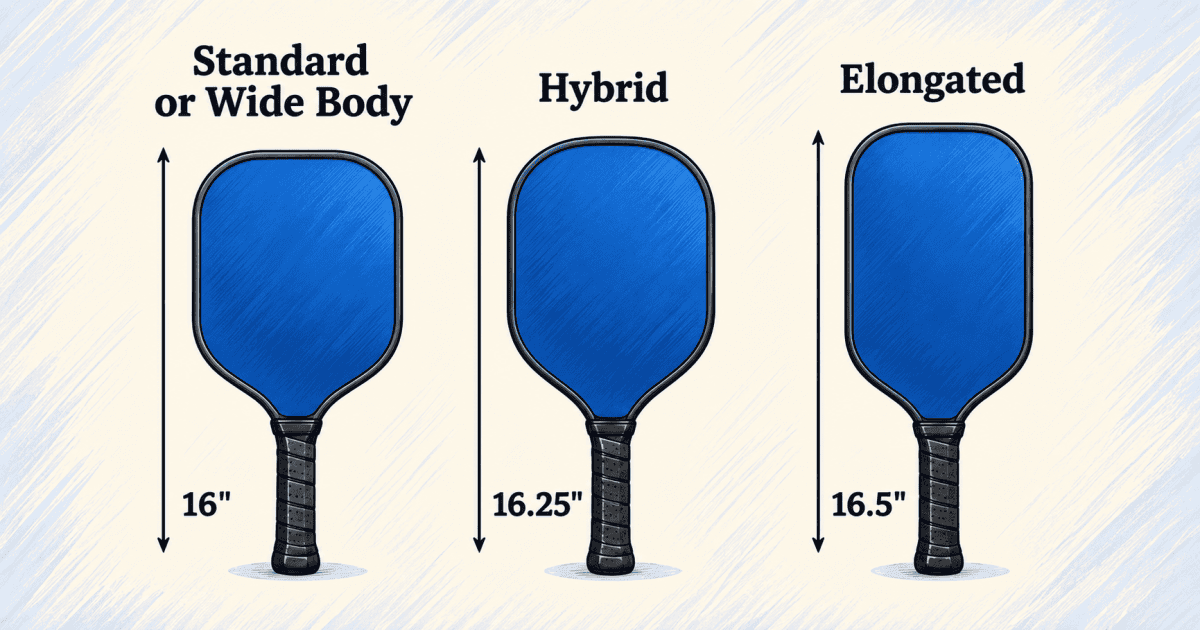
Quick Answer: Pickleball paddle shapes come in three main families: widebody, elongated, and hybrid (also called teardrop). Under the 2026 USA Pickleball rulebook, a paddle’s length plus width cannot exceed 24 inches, so every shape is a trade. Widebody buys forgiveness and quick hands, elongated buys reach and leverage, and hybrid sits between them.
The most important paddle decision is often not carbon, grit, foam, or even weight. It is shape. A paddle’s length and width decide where it reaches, how fast it moves at the kitchen, how forgiving it feels on an imperfect strike, and how much leverage it can create on a drive or serve.
Standing in front of a wall of nearly identical paddles, the choice looks harder than it is. The different pickleball paddle shapes on the market almost all fall into three families: widebody, elongated, and hybrid. A few specialty profiles, including square, standard, edgeless, and long-handle variants, live inside or alongside those groups. Every one of them is making the same trade. More length usually means less width, and more width usually means a shorter face with a larger, steadier hitting area.
What Are the Pickleball Paddle Size Rules?
The whole design puzzle starts in the rulebook. Under the 2026 USA Pickleball rulebook, Rule 3.D.2 caps a paddle’s combined length and width, including any edge guard and butt cap, at 24 inches, and caps total length at 17 inches. There is no rule on thickness and no separate rule on width, so manufacturers all work from the same dimensional budget. Spend more of it on length and the face gets narrower. Spend it on width and the face gets shorter.
That one rule explains why an elongated paddle is narrow and a widebody paddle is short. It is also why a long handle is not free: handle length counts toward the 17-inch cap, so every extra half inch of grip comes out of the hitting surface. For tournament play, shape is only half the question; the paddle also has to appear on the approved list, which the guide to USA Pickleball approved paddles walks through.
Where Did the Original Paddle Shape Come From?
The first paddles were closer in spirit to oversized ping-pong paddles than to today’s performance gear. The game’s founders improvised with ping-pong paddles in 1965, and the earliest purpose-built paddles were simple, broad-faced wooden designs. The full story of that first weekend is covered in when pickleball was invented and the history of pickleball, so it does not need repeating here. What matters for shape is that a wide, relatively short face became the sport’s foundation.
For decades, a broad standard or widebody format was simply what a paddle looked like: a large surface behind a perforated plastic ball, suited to a game built on placement. As pickleball got faster, manufacturers went looking for reach and pace without breaking the size limit, and the elongated paddle was the answer, moving some width into length. The hybrid followed when players liked the reach but not the narrower sweet spot, restoring enough width to make the face forgiving again. Those three shapes are now the sport’s main design lanes.
Pickleball Paddle Shapes Explained: What Does Each One Trade?
Shape does not make a paddle powerful, soft, spinny, or fast on its own. Core thickness, face material, surface texture, construction, balance, and swing weight all matter. But shape sets the physical conditions those traits show up in.
A longer paddle increases the distance from the hand to the ball at contact, and that distance works as leverage. On a full serve, drive, overhead, or passing shot, an elongated paddle can produce higher tip speed, especially for a player who already has a long, efficient swing. The cost is a narrower face, which tends to mean a smaller effective hitting zone and less stability when the ball strikes near an edge. That is why an elongated paddle can feel explosive on clean contact and unpredictable on rushed blocks, hand battles, or off-center volleys.
A widebody paddle reverses the equation. Its broader face spreads the striking area across more width, which generally produces a larger, more centered sweet spot and steadier routine contact. The shorter shape also tends to feel quicker in fast exchanges because less paddle extends above the hand.
Pickleball Paddle Dimensions by Shape
| Shape | Typical pickleball paddle dimensions | What it does best | The trade-off |
|---|---|---|---|
| Widebody (also called standard) | About 15.5 to 16 inches long, about 8 inches wide | Forgiveness, quick hands, stable volleys, control | Less reach and less leverage on full swings |
| Hybrid (also called teardrop) | About 16.1 to 16.3 inches long, moderate width | Balanced all-court play | Maximizes neither reach nor face width |
| Elongated | About 16.5 inches long, about 7.4 to 7.6 inches wide | Reach, drives, serves, passing shots, two-handed backhands | Narrower sweet spot, more demanding kitchen play |
Those figures vary by brand, handle length, and construction, but the relationship never changes. The 24-inch combined limit in the 2026 rulebook means no manufacturer can maximize both face length and face width at once.
Why Is Widebody the Forgiveness Shape?
Widebody paddles are the logical starting point for many newer players, particularly in the first year or two. They do not eliminate mishits, but they reduce the punishment for them.
The reason is not simply that the paddle looks bigger. Extra width changes the usable hitting area. On dinks, resets, blocks, and defensive volleys, the ball often arrives fast or slightly outside the ideal contact point, and a broader face leaves more room for a stable response. That can make the paddle feel calmer in the transition zone and more dependable at the non-volley line.
Widebody also fits the modern doubles game, where most points are decided by third-shot choices, resets, dinking patterns, speed-ups, and counters at the kitchen. A shorter, wider profile is easier to square to the ball in all of those. Dink-focused players favor it for the same reason: not because a wide face makes dinks softer, but because a larger, more centered sweet spot makes delicate contact repeatable, and repeatability is everything when the goal is a ball that clears the net by inches. When a speed-up comes at the hip, a stable, easy-to-position face matters more than reach. For a player still learning consistent contact, widebody is usually the least risky choice, and the guide to what paddle weight a beginner should use pairs naturally with it.
When Does an Elongated Paddle Make Sense?
The elongated paddle’s appeal is easy to see: a little more reach matters everywhere. At the baseline it helps with returns, passing shots, and balls that pull a player wide. At the kitchen it covers a lob, a poach in the middle, or a dink that lands just past a comfortable zone. In singles, where more court has to be covered and drives are more frequent, that coverage counts for even more. Elongated shapes also draw bangers, the players who attack with serves, drives, speed-ups, and overheads. The shape is not a power source on its own; a thin, low-power elongated paddle will not out-hit a powerful widebody. But the longer profile gives a full swing more leverage when technique, timing, and construction line up.
That same leverage makes the paddle less forgiving. Mass sitting farther from the hand is harder to redirect in a hand fight, and the narrower face can push the sweet spot higher and make strikes near the upper corners feel unstable. Many advanced doubles players use elongated paddles well. The point is that the player accepts a narrower margin for error in exchange for reach and offense.
Elongated models also draw players who hit a two-handed backhand. Brands often pair the shape with a longer handle to make room for the second hand, which suits former tennis players in particular. The catch, again, is the 24-inch budget: the handle length comes out of the same total, so a longer grip trims the face. The full comparison lives in elongated vs standard pickleball paddles.
What Is a Hybrid or Teardrop Paddle?
Hybrid paddles, often sold as teardrop shapes because the face tapers slightly from a wide lower section toward the tip, are not marketing jargon when the dimensions land between a widebody and a classic elongated design. They exist to avoid the sharper compromises of either extreme.
A hybrid is a little longer than a widebody and noticeably wider than an elongated model: more reach than a control shape without becoming as narrow or tip-heavy as a full elongated profile. For a developing player who has moved past basic contact but is not sure whether the game needs more power or more control, hybrid is often the sensible next step. It also suits all-court players whose game changes by opponent and by day, and recreational doubles players who want enough reach to attack without a paddle that punishes them in a long kitchen exchange. Hybrids rarely lead the category in any single trait. That is the point. They are built to be hard to outgrow and hard to regret, and a widebody player eyeing an elongated paddle often finds a hybrid delivers most of the reach without giving up the confidence of a wide face.
Does Paddle Shape Create More Spin?
Not directly, whatever the marketing implies. Spin comes mainly from friction between ball and face, the face’s texture and material, how long the ball dwells on the surface, and the player’s brushing path. Modern raw carbon and textured faces have made spin available in every shape category, as the guide to how paddle texture creates spin explains.
Shape does influence the swing that creates spin. An elongated paddle can help a player generate more tip speed on a full topspin drive or a dipping serve because of its length and leverage, but only if the player can control the longer paddle and keep a clean brushing path. Widebody paddles can be excellent spin paddles for players whose spin comes from compact, repeatable swings, rolls, flicks, and controlled drops, because the stability makes those shots easier to repeat. Face technology creates the spin potential. Shape changes how the paddle moves through the stroke.
Which Shape Should a Beginner Start With, and When Should You Switch?
For a beginner, a widebody or moderately wide hybrid is generally the strongest choice, because early improvement depends on clean, repeatable contact, and a larger, steadier sweet spot lets a player build serves, dinks, blocks, and volleys without every slight mishit becoming an error.
An elongated paddle becomes worth considering once a player reliably finds the center of the face and can name what the extra length would supply:
- More reach on volleys, lobs, wide balls, and overheads.
- More leverage on serves, drives, and passing shots.
- Room for a two-handed backhand.
- A better fit for singles or a consistently aggressive, baseline-first game.
A hybrid is the practical pick when the need is less certain, which describes most players who enjoy attacking but spend most of their games in doubles.
The clearest signal that a shape change would help is not a bad loss or a partner’s new paddle. It is a repeated pattern. A player whose drives and reach are real strengths but who keeps wanting more extension may benefit from elongated. A player whose game breaks down on rushed blocks and off-center volleys may gain more from moving wider. A player whose strengths and weaknesses are evenly mixed is exactly who hybrid designs were built for. Shape is less about identity than about where the game needs help. The right outline does not replace technique. It makes certain shots easier to reach and certain mistakes easier, or harder, to survive.
Frequently Asked Questions
What are the three main pickleball paddle shapes? Widebody (sometimes called standard), elongated, and hybrid, which is also called teardrop. Nearly every paddle on the market fits one of those three families, with square, edgeless, and long-handle designs as variations inside them.
What is the maximum size of a pickleball paddle? Under the 2026 USA Pickleball rulebook, Rule 3.D.2 limits a paddle’s combined length and width, including edge guard and butt cap, to 24 inches, and total length to 17 inches. The 2026 rulebook sets no limit on thickness.
What paddle shape is best for beginners? A widebody or a wide hybrid. Both give a larger, more centered sweet spot, which makes clean contact easier to repeat while a player is still learning serves, dinks, and blocks.
What is an elongated pickleball paddle good for? Reach and leverage. It helps on drives, serves, overheads, lobs, and wide balls, and it suits singles play and two-handed backhands. The trade is a narrower sweet spot and less stability on off-center hits.
What is a teardrop pickleball paddle? Teardrop is another name for a hybrid shape. The face is wider toward the bottom and tapers toward the tip, landing between a widebody and an elongated paddle in both length and width.
Does a wider paddle have a bigger sweet spot? Generally, yes. Spreading the face across more width tends to enlarge and center the sweet spot, which is why widebody paddles feel steadier on blocks and volleys.
Does paddle shape affect spin? Only indirectly. Spin comes from the face texture and the player’s brushing motion. An elongated paddle can add tip speed on a full swing, while a widebody makes compact spin shots easier to repeat, but neither shape creates spin by itself.
Does a longer handle change the paddle face? Yes. Under the 2026 rulebook, handle length counts toward the 17-inch length cap and the 24-inch combined limit, so a longer handle means a shorter or narrower hitting surface.
Picking a shape is easier with a paddle in hand than with a spec sheet on a screen. Demo programs, club loaner racks, and a few games with a partner’s paddle settle the question faster than any chart. When it is time to buy, compare paddles, grips, and everything else in the Pickler Junction gear directory.
Written by the Pickler Junction Team.