What Is a Pickleball Pop-Up Event?
Quick Answer: Pickleball pop ups are temporary courts built in a space that was not a court the day before. Think parking lots, malls, rooftops, festivals, and brewery patios. They run for a day, a weekend, or a full season, then the tape comes up and the space goes back to normal. Most are free or cheap to attend.
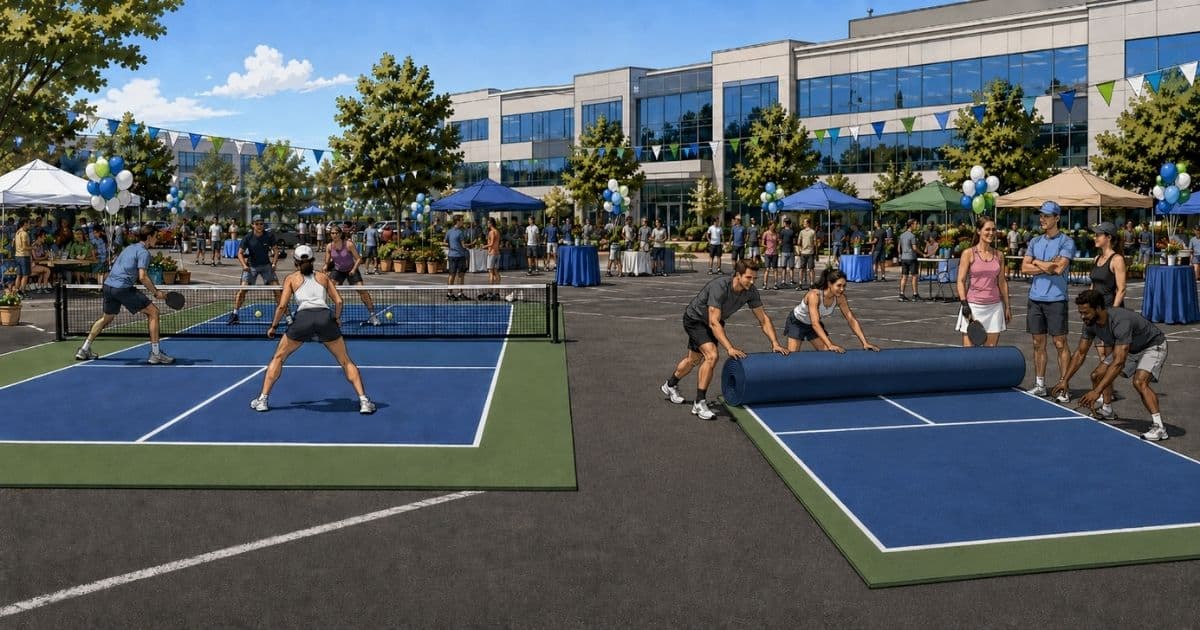
A pickleball pop up is a temporary court installation placed in a public or private space for a limited run and then removed. The name throws people who assume it describes a shot. It describes real estate.
The format took off for a plain reason. SFIA counted 24.3 million US pickleball players in 2025, up from 4.2 million in 2020, and permanent court construction has not kept pace. A parking lot with tape and a portable net can hold four players tonight.
What Actually Counts as a Pop-Up?
Any playable court that gets installed and then removed counts. Run length is what separates one kind from another, and it ranges from a single afternoon to several months.
The common formats:
- Single-day activation. A brand, health system, or employer sets up one or two courts at a festival, a mall, or a company campus for six to eight hours.
- Weekend takeover. Several courts plus a schedule of clinics and open play, almost always tied to a sponsor.
- Seasonal residency. One court or a small block of courts that lives in a plaza or on a rooftop for a summer.
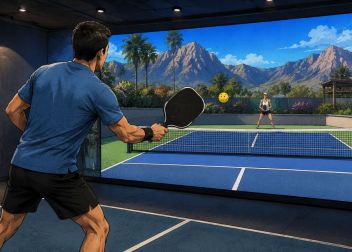
- Venue conversion. Courts taped onto a surface that already exists, such as a tennis court, a gym floor, or a warehouse bay.
That last one blurs into ordinary court sharing, since taping a pickleball layout onto an existing tennis court is a conversion more than an event.
Who Runs Pickleball Pop-Ups?
Four groups run most of them: city and waterfront nonprofits, national brands buying reach, property owners filling underused space, and event companies that rent courts by the day.
Real examples, all recent:
- CityPicklePalooza at Times Square Plaza in New York ran August 26 to 30, 2026, with free open play across all five days. CityPickle produced it with the Times Square Alliance, backed by JOOLA, Mount Sinai, Nespresso, and Zespri.
- National Mall of Pickleball in Washington, DC is run by the Trust for the National Mall with Humana and the Humana Foundation. The 2025 edition put 11 temporary courts near the Smithsonian Metro station on 12th Street NW from September 19 to 21, free to attend.
- Baltimore Inner Harbor. The Waterfront Partnership of Baltimore, with PNC Bank, ran a single temporary court at the Inner Harbor Amphitheater from July 17 to August 28, 2026. Paddle and ball rental was $5 an hour through Toss and Spin, with clinics and open play alongside SOS Pickleball.
- Tyrone Square Mall in St. Petersburg, Florida hosted a free public day on October 25, 2025, run by Humana with Simon Properties. It included coaching clinics, SilverSneakers warm-ups, a recovery station, and pro appearances.
Two patterns jump out of that list. Health insurers keep turning up as the money behind these, and the largest ones tend to be the free ones.
What Does It Cost to Attend?
Usually nothing, and where there is a charge it is small. Every sponsored pop-up listed above was free to play. Baltimore charged $5 an hour for gear rental, with the court time itself reservable in advance.
Paid pop-ups do exist, mostly seasonal ones run by court operators who sell hourly reservations the way a pickleball entertainment center does. If a pop-up has a bar, a DJ, and a booking app, expect a fee. Bring your own paddle when you can, because loaner paddles at a free event go fast and the ones left are rarely the good ones.
What Does a Host Pay to Put One On?
Court rental vendors quote by the job instead of publishing a price list, so the honest answer is that it depends on court count, run length, and how much labor the vendor supplies. Full-service rental covers delivery, assembly, the playing surface, regulation lines, and teardown.
The cost drivers a host controls:
- Number of courts, since each one needs its own footprint
- How many days the build stays up
- Material-only delivery versus full-service installation
- Nets, paddles, balls, and barrier netting
- Staffing for check-in, clinics, and gear
- Permit fees and the insurance certificate
Park use permits commonly run $25 to $150 per event, with seasonal permits available for recurring play. Applications typically ask for the group name, expected attendance, dates and times, and proof of liability insurance, and processing takes anywhere from a few days to several weeks. The permit is what sets the calendar, so it gets started first.
Companies booking courts for a team day run the same playbook on private property, which skips the park permit entirely and cuts the lead time down to whatever the vendor’s calendar allows.
What Do the Courts and Nets Actually Look Like?
Interlocking tile laid over asphalt or concrete, secured with removable tape, with lines painted to regulation. RG Event Surfaces rents the tile as material only or as a full-service install. Portable Pickleball in Huntington Beach asks for a flat area of at least 30 by 60 feet and budgets four to six hours to build a court.
The measurements do not shrink because the court is temporary. USA Pickleball puts the court at 20 by 44 feet, calls 30 by 60 feet the minimum recommended total playing surface, and lists 34 by 64 feet as preferred. The net stands 36 inches at the sidelines and 34 inches at the center. Any hard surface works outdoors as long as it is clear of debris.
Nets are the other half of the build. A pop-up runs on freestanding portable nets, which is why a windy plaza needs weighted bases and a check on net height between games. The tradeoffs are covered in our comparison of portable versus permanent pickleball nets.
Surface prep matters more than the tile brand. A lot with a crown, a drain, or loose gravel will telegraph every bounce, and shade and glare change how a plaza plays hour to hour. Builders who handle permanent installs are listed under court construction and infrastructure.
Where Do People Find Them?
Pop-ups get advertised locally and vanish from search fast, so the reliable sources are the organizer’s own page, the city or parks calendar, and the property owner’s events page. Pickleheads, the official court and game finder of USA Pickleball with over 25,000 places to play, picks up some temporary courts once they open.
Scanning a local events calendar the week before works better than searching the phrase itself, since plenty of these are billed as a festival or a block party that happens to have courts. The same is true of the bigger multi-day versions covered in our guide to what a pickleball festival is.
FAQ
What is a pickleball pop-up event? It is a temporary court setup placed in a space that is not normally a court, such as a plaza, mall, rooftop, or parking lot. It runs for a set window and then gets taken down. The term describes the venue arrangement rather than any kind of shot.
How much does it cost to play at a pickleball pop-up? Most sponsored pop-ups are free to play, including the National Mall of Pickleball and CityPicklePalooza in Times Square. Some charge a small rental fee, such as the $5 an hour paddle and ball rental at Baltimore’s Inner Harbor court. Seasonal pop-ups run by commercial operators usually sell court time by the hour.
Do I need to bring my own paddle? Bringing one is the safer bet. Free events usually stock loaner paddles, but supply runs thin at peak hours and the remaining stock tends to be entry-level. Balls are almost always provided.
How long do pop-up pickleball courts stay up? Anywhere from one afternoon to a full season. The Tyrone Square Mall event ran a single day. The Baltimore Inner Harbor court stayed up six weeks. Rooftop and plaza residencies often run a whole summer.
Can you put a pickleball court in a parking lot? Yes, and parking lots are one of the most common pop-up surfaces. USA Pickleball says any hard surface such as concrete or asphalt works for outdoor play as long as it is free of debris. The lot needs to be flat, and the space needs to clear the recommended footprint.
Do you need a permit for a temporary pickleball court? On public land, yes. Park use permits generally cost $25 to $150 per event and require proof of liability insurance along with attendance estimates and time windows. On private property such as a mall lot or a corporate campus, the property owner’s approval and an insurance certificate usually cover it.
How much space does a pop-up pickleball court need? The court itself is 20 by 44 feet. USA Pickleball recommends a total playing surface of at least 30 by 60 feet, and prefers 34 by 64 feet. Portable court vendors ask for a flat area of at least 30 by 60 feet per court.
How long does it take to set up a portable court? Around four to six hours per court for a tiled surface, depending on size. Simpler setups that use tape lines and a freestanding net go up far faster. Teardown is quicker than the build.
Where can I find pickleball pop-ups near me? Check the city or parks department events calendar, the mall or waterfront property’s own events page, and Pickleheads for temporary courts that have already opened. Local club and league pages tend to announce them earliest.
Pop-ups are terrific, and then they are gone. For the places that stay put, browse pickleball entertainment centers in your area, keep an eye on the tournaments and events listings for the next one rolling through, and use the public courts listings for the Tuesday night that has no sponsor and no DJ.
Written by the Pickler Junction Team.