How to Find Your Pickleball Community
Quick Answer: Start with public court open play, which is free and built for players who show up alone. Add a local Facebook group, since that is where most towns organize informal sessions. USA Pickleball’s 2025 data puts the sport at 24.3 million players nationwide, so a scene exists in nearly every area. Pick one session and return to it weekly.
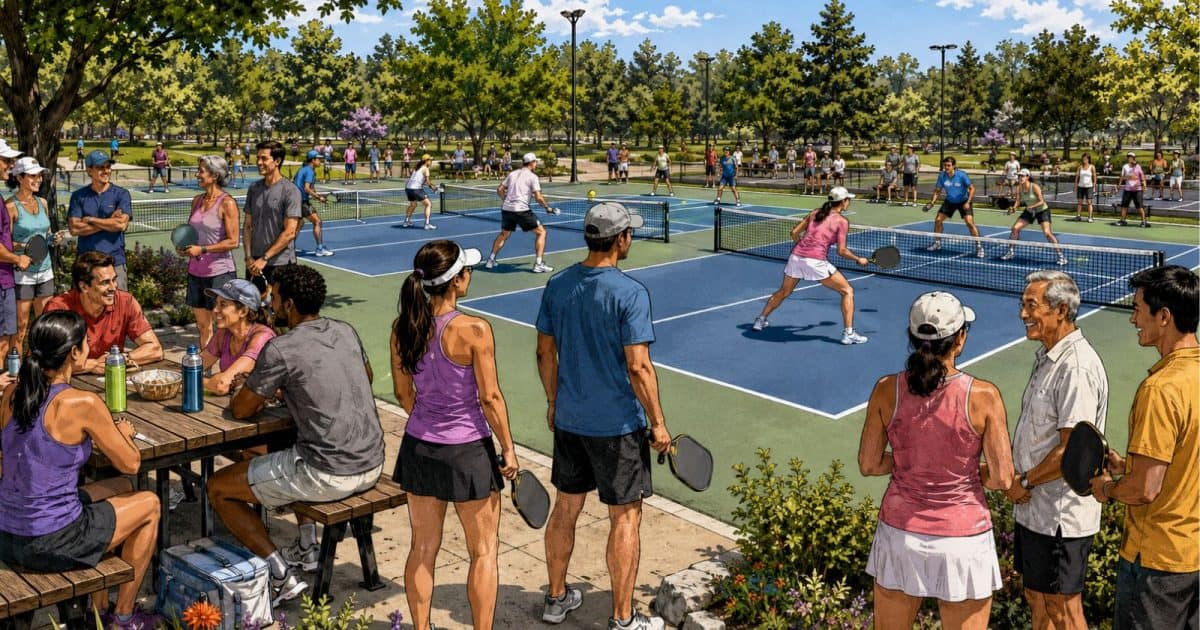
A pickleball community is the group of people a player regularly games with. In this sport, that group tends to form around one specific session and time, not around a single club.
Where a pickleball community actually lives
Four places, and they are not equally useful.
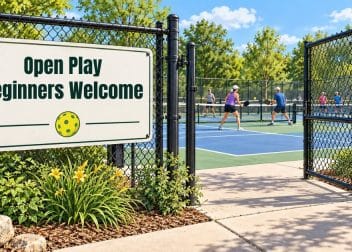
Public court open play is the front door for most players. It costs nothing and it is built for someone who shows up without a partner. Pickleheads, a court finder site, had profiled more than 25,000 courts across the country as of September 2026, which makes it easier to see where the open play sessions actually happen. See what open play is and how to find public pickleball courts nearby.
Local Facebook groups are where informal sessions get organized in most towns, and they carry information no directory has, like which court gets crowded at 6 p.m. or who still needs a fourth for Saturday.
Clubs offer the same faces repeatedly, which is what turns acquaintances into friends. Many clubs also expect members to carry a USA Pickleball membership on top of local dues. USA Pickleball’s Casual tier is free, the Challenger tier is $12 a year, and the Champion tier is $60 a year, according to USA Pickleball’s membership page. See how to find a pickleball club near you.
Leagues, ladders, and local tournaments assign a player partners and opponents, which removes the need to insert yourself into an existing group. Check how to find pickleball tournaments in 2026 for one route in.
Why going to the same session matters so much
Because familiarity is built by repetition, and pickleball rotates players through games fast enough that repetition works quickly.
Going to five different sessions once each puts a new player in front of many strangers. Going to one session five times puts that player in front of the same people repeatedly, and by the third visit they know a name and a backhand. That is when invitations start.
There is also a wellbeing case for sticking with one group. A 2023 systematic review in Frontiers in Psychology, covering 13 studies on pickleball and mental health, found consistent improvements in wellbeing, life satisfaction, and stress among regular players. A stable group to play with is part of what makes the habit stick.
Pick a session that fits a reliable schedule, not the one with the newest courts. An ordinary court visited every week does more for a social circle than a nicer court visited twice.
What actually helps you fit in
Small things, and they matter more than skill level.
- Learn names. On a court this size, it is easy to do and easy to be remembered for.
- Say yes to games above your level. Losing to better players is often how new connections start.
- Stay ten minutes afterward. A lot of the socializing happens off the court, once the games end.
- Show up when planned. Being reliable gets a player invited back more than raw skill does.
- Ask what else people play in. That is how a player learns about leagues, private groups, and sessions that never get advertised publicly.
Read open play etiquette before a first session so the unwritten rules are not the obstacle.
If you are new to the sport too
That helps more than it hurts.
A beginner has an obvious reason to talk to people and ask questions, and experienced players tend to enjoy being asked. A beginner clinic is one of the strongest entry points, because everyone arrives knowing no one and the coach handles the introductions. Group clinics typically run $20 to $50 per person for one to two hours, and private coaching runs $50 to $100 or more per hour, so a clinic is also the cheaper way to test the sport before booking lessons.
Start with pickleball tips for beginners so the sport itself is not the obstacle.
Whether this works everywhere
Better in some places than others, and it helps to be realistic about it.
In a metro area with an active scene, a community can come together in a few weeks. In a small town with two courts and no organized play, a new player may end up being the person who starts it, which is a different project. The guide to starting a pickleball club covers that path.
The age mix is one of the sport’s real advantages either way. Courts nationwide have people in their twenties playing next to people in their seventies, and that wide draw is part of why the sport grew from roughly 4.2 million US players in 2020 to an estimated 24.3 million in 2025, according to Sports and Fitness Industry Association data cited by USA Pickleball. Some regions also have dedicated 55-and-over communities built around the sport; see what to ask about a 55-plus pickleball community for what that looks like day to day.
FAQ
How do I find a pickleball community near me? Start with public court open play and a local Facebook group, then commit to one session and go back to it repeatedly.
Do I need to join a club? Not to start. Public open play is free and has more turnover of new faces. A club plus a USA Pickleball membership, which starts at $12 a year for the Challenger tier, makes more sense once a player wants the same group regularly.
How long does it take to feel part of a group? Often about three visits to the same session. Repetition at one time slot builds it, and a 2023 Frontiers in Psychology systematic review linked consistent pickleball participation to better wellbeing and lower stress.
What if I do not have a partner? Open play is designed for exactly that. The paddle queue puts a player into games with whoever is next in line.
Where do people organize sessions? Local Facebook groups, mostly. They carry information about informal play that no directory or app tracks.
Is the community welcoming to beginners? Generally yes, and a beginner clinic is the easiest entry because everyone there is in the same position, usually for $20 to $50 a session.
What if there is no scene where I live? A new player may end up being the one who starts it. A regular time, a public court, and a Facebook post is how a local scene typically begins.
Does age matter? Less than in most other adult sports. Wide age ranges playing together, sometimes fifty years apart, are normal on a pickleball court.
Public courts and local clubs are the fastest way to test a session before committing to one group. Pickler Junction’s directory of pickleball clubs lists options by location, and open play at a public court remains free to try first.
Written by the Pickler Junction Team.