Pickleball Drama: Handling Conflict at the Courts
Quick Answer: Most court conflict comes from three things: line calls, queue disputes, and people playing at the wrong level. The fix in each case is the same shape. Address it quietly, early, and away from the court, rather than loudly and mid-game. Etiquette prevents most of it before it starts.
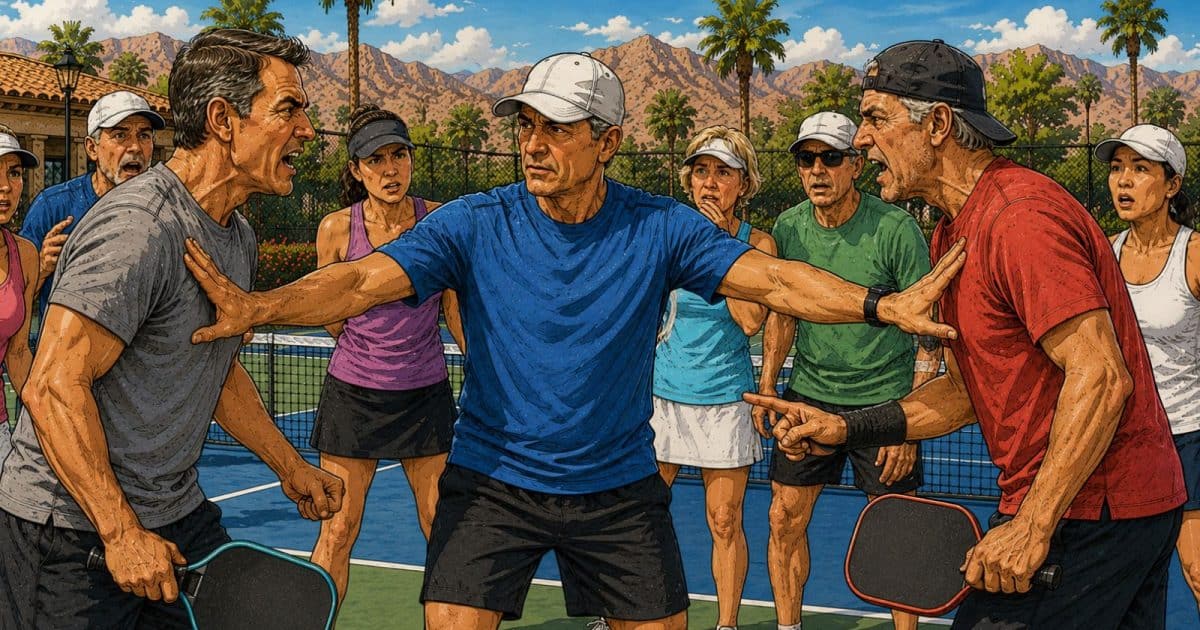
Pickleball drama is interpersonal conflict at the courts, usually over calls, court access, or behavior, rather than over the game itself.
Why a friendly sport produces so much of it
Three structural reasons, and none of them are about the people.
Players call their own lines. There is no referee in recreational play, which puts every close ball in the hands of someone with an interest in the outcome.
Courts are scarce. Where demand exceeds supply, the queue becomes contested, and queue disputes follow.
Levels mix. Open play throws a 3.0 and a 4.5 into the same game regularly, and both leave frustrated.
Add that the sport grew fast, so many courts have a group of long-time regulars and a steady stream of newcomers who do not know the local norms, and the friction is fairly predictable.
Handling a line call dispute
The rule is simple and it is the one thing that resolves nearly all of them.
The call belongs to the team the ball lands on. Not to the hitter, not to the person with the best view in their own opinion. Unless your team is certain the ball was out, it is in. That standard is the norm across recreational play and it exists precisely because certainty is rare.
If someone else makes a call you disagree with, the useful response is to let it go. One point is worth less than the next hour. If a pattern develops across a whole session, that is worth a quiet word afterwards, not an argument at the net.
Handling queue disputes
By making the queue visible, which prevents most of them.
A paddle rack that everyone can see is self-policing. Disputes cluster where the system is ambiguous, where regulars hold courts by playing continuously as a fixed four, or where nobody has explained the system to a newcomer.
If you run a session, that is your job to fix, and a posted rotation that everyone can see removes most of the argument. If you are a player, the productive move is to ask how the rotation works rather than to assume the worst about someone who took the court ahead of you.
Level mismatches
The most common source of quiet resentment and the one nobody says out loud.
A stronger player stuck in easy games is bored. A newer player being dominated is discouraged. Neither usually says anything, and both go home unhappy.
The fix is structural rather than interpersonal. Sessions sorted by level solve this and almost nothing else does. Where a session is not sorted, the workable norm is that stronger players make an effort to keep games competitive and newer players do not take a hard game personally.
If you are the stronger player, the generous move is to play the balls that make a rally rather than the ones that end it. It costs you nothing and it is remembered.
What prevents most of it
Etiquette, applied consistently and early.
Call the score clearly. Give calls away when uncertain. Do not hold a court. Welcome newcomers and explain the system. Do not coach someone who has not asked. Do not complain about a partner’s play, ever.
Our full guide to pickleball open play etiquette covers the norms in detail. Nearly every conflict at a public court traces to one of them being broken.
When it is worth escalating
Rarely, but there are exceptions.
Persistent bad calls from the same player, someone who consistently jumps the queue, or behavior that makes people uncomfortable are worth raising with whoever runs the session or the facility. That is what organizers are for.
Anything involving aggression or a safety issue goes straight to the facility, not to a conversation between players.
FAQ
Who makes the line call in pickleball?
The team the ball lands on. Unless they are certain it was out, it is in. That standard exists because certainty on a close ball is rare.
What should I do if someone makes a bad call?
Let it go in the moment. One point is not worth the next hour. If it becomes a pattern across a session, have a quiet word afterwards.
Why is there so much conflict at public courts?
Self-officiating, scarce court time, and mixed levels in the same games. All three are structural rather than personal.
How do I handle someone hogging a court?
Ask how the rotation works rather than confronting them. If there is no system, the session needs one, which is a conversation with whoever runs it.
What if I am much better than everyone in my game?
Play the balls that extend the rally rather than the ones that end it. It costs nothing and people remember it.
Should I tell someone they are playing above their level?
Almost never on court, and never publicly. If it is a session-wide problem, it is a scheduling issue for the organizer.
When should I involve the organizer?
Persistent bad calls, repeated queue jumping, or anything that makes people uncomfortable. Aggression or safety issues go to the facility directly.
Does this get better at clubs?
Usually, because clubs sort by level and have someone responsible for the session. Most of the friction at public courts comes from having neither.
If you are looking for a session that is run rather than improvised, our club listings cover what is near you.
Written by the Pickler Junction Team.