What Age Can Kids Start Pickleball Lessons?
Quick Answer: Most children are ready for structured pickleball lessons around ages 6 to 9, according to the American Academy of Pediatrics, once they can track a moving ball and follow group instruction. Informal driveway play with a soft ball can start earlier. Readiness depends on a child’s motor skills and attention span far more than the calendar.
The honest answer is a range plus a checklist, because readiness is developmental, not calendar based. Pickleball asks less of small bodies than most racquet sports. That is exactly why the age range starts so young.
Why is pickleball so kid friendly compared to tennis?
The scale of the game already fits a child. Almost everything that makes tennis hard for a seven year old is smaller, slower, or lower here.
Under the official pickleball rulebook, the court measures 20 by 44 feet, a fraction of a tennis court. The net stands 34 inches at the center, close to waist height for a small child. Paddles are short and light compared to junior tennis racquets, and the plastic ball moves slowly with a low bounce.
USA Pickleball’s official rules summary also requires the serve to travel in an upward arc, with paddle contact below the waist. That underhand motion removes the hardest skill in junior tennis, the overhead toss and swing, and lets a beginner rally on day one. Games are normally played to 11 points, win by two, which suits a young attention span better than a full length tennis set.
The four player doubles format keeps kids moving and involved instead of stuck in a deep court corner waiting for the ball. Families new to the game can start with the primer on what pickleball is and how it is played, which covers the rules a parent will be asked to explain in the car.
How do you know your kid is ready for lessons?
Watch the checklist, not the birthday. According to the American Academy of Pediatrics, most children develop the basic motor skills and attention span for simple organized sports between ages 6 and 9, though readiness depends on the individual child far more than the calendar year.
- Tracks a moving ball and moves toward it instead of watching it land.
- Holds and swings the paddle with control, not just grips it.
- Follows two step instructions in a group without one on one help.
- Handles taking turns and short waits, since group lessons involve both.
- Wants to be there. Interest outranks every other sign on this list.
A backyard or driveway session with a soft ball and a short paddle works as a simple, low-cost test. Ten minutes of casual play shows whether the tracking and the interest are both present, long before a formal class does.
When the checklist mostly passes, start with lessons built for children instead of dropping a child into adult instruction. The pace, the language, and the games differ. A class designed for adults, like the one described in the guide to what to expect at a pickleball clinic for beginners, assumes a patience a young child should not be expected to have yet.
What should kids’ first lessons look like?
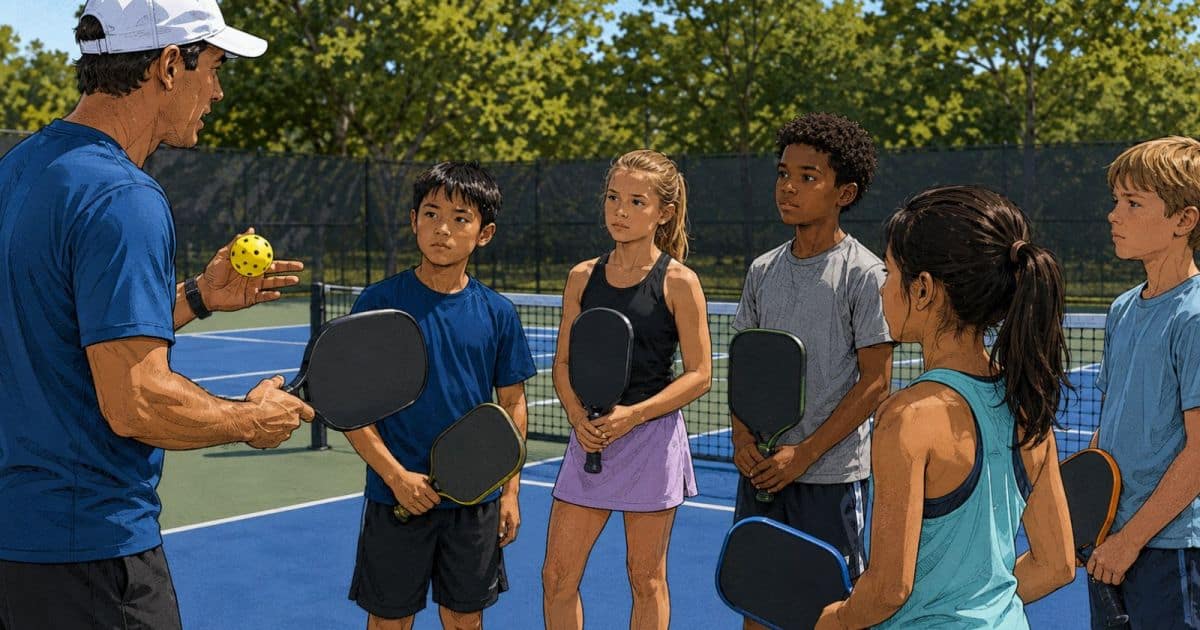
Games dressed as drills, short blocks, and lots of hitting. Good junior instruction is recognizable at a glance because everyone is moving and laughing instead of standing in line.
Expect balloon and beanbag tracking games for the youngest players, target games for serves, and rally counting instead of full scoring for the first stretch. Focused blocks run 20 to 30 minutes inside an hour long session, with the rest spent on movement games that double as footwork. Groups stay small, and equipment gets scaled down: lighter paddles, softer balls indoors, and properly fitted shoes built for kids once real movement starts.
A good class will not include line drills, lectures, or an hour spent on a single grip. Children learn this sport by playing it. The technical polish arrives later, and faster, for the kids who fall in love with the game first.
Vetting a junior coach follows the standard process, with one addition: ask specifically about experience teaching children, since coaching kids is a separate skill from coaching adults. The questions in the guide to finding a pickleball coach still apply, plus that one.
How do families make it stick?
Play together, keep sessions short, and let a child win sometimes, honestly.
Pickleball is one of the few sports where a mixed age family foursome can share a court for real rallies. The underhand serve and the slow ball flatten the physical gap between a grandparent, a parent, and a nine year old. That family game does more for a child’s continued interest than any single lesson block, and it is where lesson content gets practiced without anyone calling it practice.
Keep sessions shorter than a child’s limit rather than at it, and end while interest is still high. A typical path runs from balloon rallies in the garage to confidently calling line faults on the adults over roughly two summers. The biggest factor is that nobody ever makes it feel like a class.
As interest grows, junior programs give kids their own cohort, which matters more with age. USA Pickleball organizes competitive junior divisions for players 12 and under, 13 to 14, and 15 to 16, so a child eventually gets peers instead of only adult opponents. Details on how those brackets work are in the guide to age divisions in pickleball.
FAQ
What age can kids start pickleball lessons? Most children are ready for structured group lessons between ages 6 and 9, according to the American Academy of Pediatrics. Informal family play can start earlier, and readiness signals matter more than the exact age on a birth certificate.
Can a 4 year old play pickleball? Casually, yes, with balloons, soft balls, and a short paddle in a driveway. Formal group lessons that young are usually premature outside a program built specifically for preschoolers.
Is pickleball easier for kids than tennis? Yes. Under the official pickleball rulebook, the smaller 20 by 44 foot court, the 34 inch net, the light paddle, and the required underhand serve remove most of the barriers that stall young tennis beginners.
What equipment does a child need? A light, short paddle scaled to their size, along with standard balls or a softer foam ball indoors. Court shoes matter once a child starts real lateral movement.
Are group or private lessons better for young kids? Groups, in most cases. Children learn this sport socially, and a junior group supplies the games and the peers that keep a child coming back.
How long should a kids pickleball session run? Under an hour, with focused blocks of 20 to 30 minutes inside it. Ending a session before attention runs out works better than filling every minute.
Can kids play on regular adult courts? Yes. The court is the same size for every age group, which is part of why the sport works so well for families. Quieter time slots suit short, early rallies best.
When can kids play in tournaments? Under the USA Pickleball junior program structure, divisions run 12 and under, 13 to 14, and 15 to 16. Readiness for competition depends on sustained rallies and handling scoring pressure more than on hitting a specific age.
Families looking for a program nearby can browse youth sessions and junior classes in the pickleball camps and clinics directory, where local instructors list age ranges and class sizes before anyone has to sign up.
Written by the Pickler Junction Team.