What Happens at a Pickleball Skills Assessment?
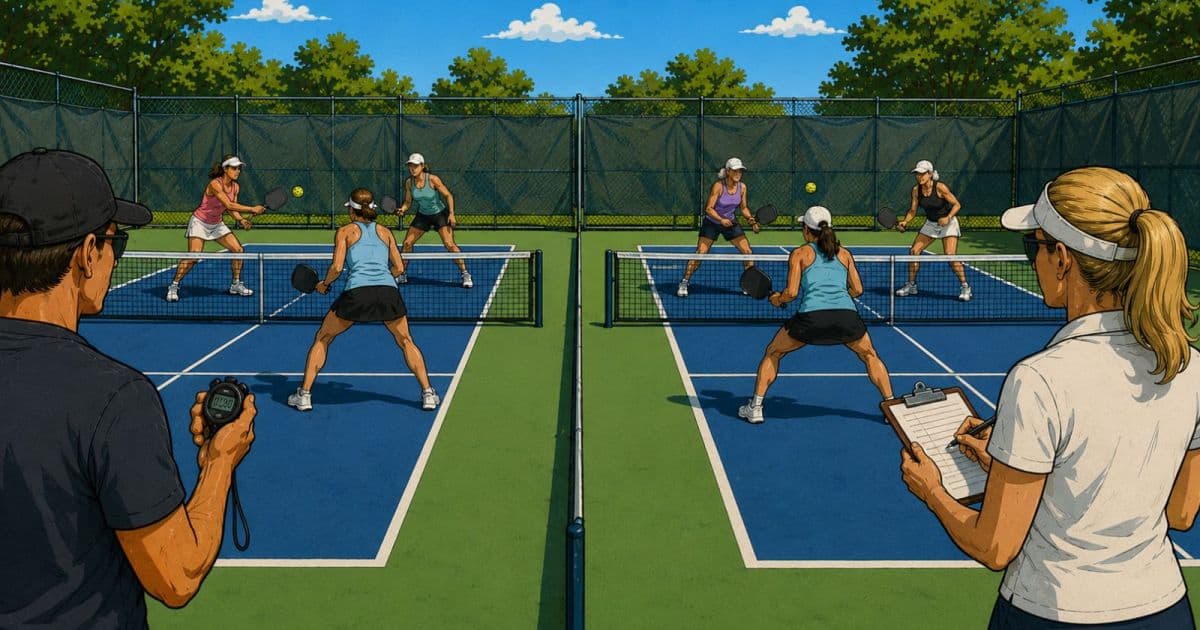
Quick Answer: A pickleball skills assessment is a structured on-court evaluation, usually 60 to 90 minutes, where a coach tests your serve, dinks, volleys, and live play against real targets. You leave with a skill rating, a written report on your strengths and gaps, and a recommended next step for lessons or clinics.
An assessment measures your game as it stands right now. The coach spends that hour finding out what you actually do on court, not what you believe you do, and the two turn out to be different more often than most players expect.
What does the coach actually test?
A typical assessment moves through the full shot inventory, then adds live play, because the two often disagree.
- Serves and returns, checked for depth and consistency, often counted against a target zone.
- Third shot drops and drives, the shots that decide whether you reach the non-volley zone line.
- Dinking, sustained crosscourt and straight-on exchanges under gradually rising pressure.
- Volleys and hands, blocks and counters right at the kitchen line.
- Resets and defense, what happens when the coach attacks you from mid-court.
- Movement and positioning, watched throughout the session rather than tested on its own.
- Live points, usually against the coach or an assistant, where habits take over from intentions.
Counting matters more than any single highlight. A strong assessor tracks consistency, such as how many of ten drops land inside the non-volley zone, rather than judging your best swing of the day. One clean drop proves little, since almost everyone hits one eventually. Landing seven of ten is a skill worth naming.
What do you get out of it?
An assessment produces three things: a number, a written map, and a direction, roughly in that order of appeal and the reverse order of usefulness.
The number is a skill rating. USA Pickleball’s official skill rating scale runs from 1.0 to 5.5+, according to usapickleball.org, and clubs commonly use the 2.5 to 5.0 range inside that scale to sort recreational and competitive players into clinics and drill groups. If you also play rated matches or carry a DUPR rating, the assessment adds context rather than replacing it. DUPR calculates its rating from match results over time on a 2.0 to 8.0 scale, according to dupr.com, so it measures outcomes while an assessment measures mechanics. The two answer different questions, and the explainer on what a DUPR rating means in pickleball covers how the match-based number works alongside a coach’s evaluation.
The map is the written report: which shots held up, which broke down under pressure, and the one or two causes sitting underneath several symptoms. This document is the real product. A useful report names something specific and fixable, such as a backhand dink struck too far from the body, instead of a vague note like needs more consistency.
The direction is the recommendation: which format fits your gaps and level. Sometimes that means group clinics, and sometimes it means individual lessons, a tradeoff covered honestly in the comparison of clinics versus private lessons.
How should you prepare for one?
Very little, and that is the honest advice. An assessment works best on your normal game, not your best game.
Warm up properly, bring your usual paddle, and resist the urge to perform. Players who swing for winners for the full session get assessed as exactly that player, and the resulting plan fixes the wrong things. The useful outcome comes from playing the way you play on an ordinary Tuesday, misses included. The coach needs your real error patterns, because those patterns are the entire point of the exercise.
The one genuine preparation is a short list of goals. Know what you want from the sport over the next year, since a coach’s recommendation changes if your goal is tournament play instead of holding your own at open play. Be ready to state your last honest rating too, without defending it if the counted drills land lower than you expected.
Many players walk into a first assessment rated about half a point higher than the counted drills confirm. Ten repetitions of anything make an honest jury.
Where do assessments happen, and what do they cost?
Assessments happen at clubs, clinics, and with private coaches, and pricing generally follows lesson rates since the session occupies the same hour on the schedule.
Many group programs run a short assessment inside a first session, mainly for placement. That version is often free, but thin: it sorts you into the right group and produces no written report. The standalone assessment with a full report is worth paying lesson rates for, and it earns its cost at two points: when you are new enough not to know your gaps, and when you have plateaued and cannot see why.
As of September 2026, group clinics typically run $20 to $50 per person, and private coaching runs $50 to $100 or more per hour. A standalone skills assessment usually falls somewhere in that range, depending on length and whether a written report is included.
Booking one follows the same process as booking any lesson, and the vetting steps in the guide to finding a pickleball coach apply unchanged, with one addition: ask to see a sample report before you pay. Coaches who run assessments well keep one on hand, and the sample tells you whether you are buying a map or a guess.
Rated ladder nights and club evaluations serve a similar sorting function, but they usually output a number only. If you want to know what to fix, look for the version that comes with writing.
FAQ
What is a pickleball skills assessment? A structured evaluation, typically 60 to 90 minutes, where a coach tests each shot against a target and watches live play, then produces a rating plus a written report on strengths and gaps.
How long does a skills assessment take? Most standalone assessments run 60 to 90 minutes. A placement check folded into a first clinic session runs shorter and produces less detail.
What rating scale do assessments use? USA Pickleball’s official skill rating scale runs from 1.0 to 5.5+, according to usapickleball.org, and most club assessments place recreational and competitive players in the 2.5 to 5.0 range inside that scale.
Should you practice before an assessment? Warm up, yes. Train specifically for it, no. The evaluation is most useful on your ordinary game, error patterns included.
Is an assessment worth it for beginners? Within the first few months of steady play, yes, because it replaces guesswork with a written plan. A very first session is usually better spent in an introductory clinic instead.
What is the difference between an assessment and a DUPR rating? DUPR calculates a rating from match results over time on a 2.0 to 8.0 scale, according to dupr.com. A skills assessment diagnoses the mechanics behind those results in a single session. The two answer different questions and work well together.
What should a skills assessment report include? Specific findings for each shot, consistency counts, one or two root causes, and a recommended next format. A vague report is a sign of a weak assessment.
How often should you get reassessed? After a sustained block of coaching, commonly a few months, or whenever a plateau resists your current plan. Once a year is enough for casual players.
Curious what an assessment would reveal about your own game? Browse verified pickleball camps and clinics near you, since most structured programs open with exactly this kind of evaluation.
Written by the Pickler Junction Team.