Do Pickleball Coaching Certifications Matter?
Quick Answer: A coaching certification is a floor, not a guarantee. PPR and IPTPA test teaching methodology, safety, and rules knowledge through coursework and an evaluation, not playing skill. PPR’s Associate Coach and IPTPA’s Level I mark the minimum standard for new coaches. Weigh it most as a beginner, less once you can judge a coach yourself.
A coaching certification is a credential from a training organization confirming the holder completed coursework and passed an assessment in how to teach pickleball. The operative word is teach. Certification programs test instruction skills, not playing level, and that distinction settles most of the debate over whether the credential is worth chasing.
What does a certification actually verify?
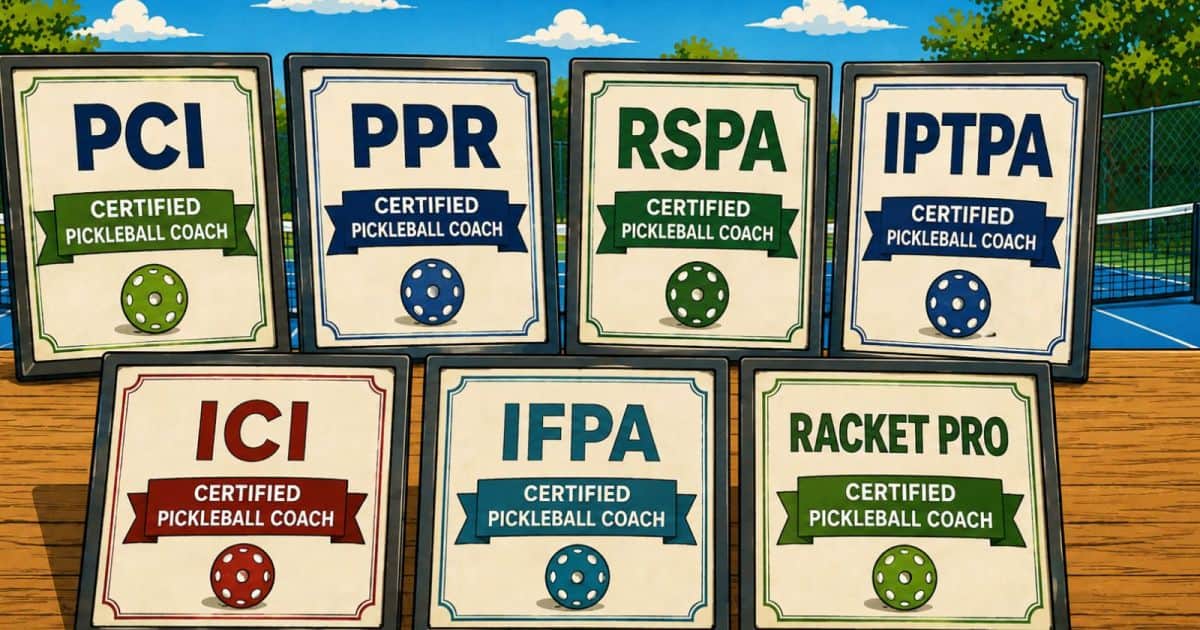
A certification verifies that a coach studied a teaching system and passed someone else’s evaluation of it. The two programs most active in the United States, PPR (Pickleball Professional Registry) and IPTPA (International Pickleball Teaching Professional Association), cover similar ground even though their exact ladders differ.
Coursework and testing in these programs typically include:
- Progressions, the ordered steps for building a shot from scratch.
- Error detection, diagnosing why a ball keeps missing rather than just noting that it does.
- Drill design and group management, a separate skill from playing well.
- Safety basics, from warm ups to coaching older students on hard courts.
- Rules knowledge, tested in writing.
- An observed teaching evaluation, required at the higher tiers.
PPR issues three ratings built on that model. Associate Coach requires a minimum 3.5 skill level and a passing score of 75 percent or higher on the written exam, according to pprpickleball.org. The Coach rating requires a 4.0 skill level with tournament experience and an 80 percent exam score, and the Pro rating requires a 4.5 skill level, tournament participation, and a 90 percent score, all per the same source.
IPTPA structures its ladder differently. Level I, the entry credential, requires a 12 hour online course, a 4 hour on court evaluation, and an online exam, according to iptpa.com. Level II requires an active Level I certification plus a skills test and an observed lesson. IPTPA also lists specialty tracks: a Certified Rating Specialist credential for coaches who assess player skill levels, and a Certified Junior Pickleball Instructor credential for coaches who work with kids, per the same source.
The fees vary too, and both change enough to date them. PPR’s certification workshop runs $197 as of September 2026, which covers study materials and testing, according to pprpickleball.org. IPTPA’s Level I certification runs $320 to $390 depending on location, according to iptpa.com. Neither number tells you anything about a specific coach’s classroom skill. It tells you the coach was willing to pay for, study for, and pass a standardized test.
What can a certification not tell you?
Whether the lessons will actually be good. That is the real limitation, and it is worth stating plainly.
Certification cannot measure patience, communication, or the one sentence that fixes a swing on the spot. Skilled teachers exist without any credential, including tennis instructors who crossed over with decades of teaching craft already built. Mediocre teachers exist with credentials too, because passing a course once is not the same as teaching well every single session.
It also says little about a coach’s own playing strength, by design. A tournament level player can be a poor teacher, and a 3.5 player can be an excellent one, because the exam tests the second skill, not the first. If a coach’s highlight reel is the main selling point, that says what the coach is good at, and it is not necessarily teaching.
A player’s best coaching hour often comes from a certified instructor who never once hits a ball during it, and the worst from a far better player who narrates instead of teaches. That distinction is worth taking to heart before booking anything.
How should you actually weigh certifications?
By who you are and what you are buying. The credential does the most work exactly where you know the least.
Beginners get the most protection from it. A new player cannot judge teaching quality in advance, and certification screens out the worst outcomes: wrong rules, unsafe progressions, improvised instruction with no plan. If you are booking a first lesson, favoring a certified coach is the sensible default. See how to find a pickleball coach for the full vetting list.
Experienced players can weigh it more loosely, since one session tells a 4.0 player most of what a certificate claims. Teaching reputation, specialization, and fit matter more than the credential at that level.
Cost is part of the calculation too. Private instruction from a certified coach commonly runs $50 to $100 or more per hour, and group clinics run $20 to $50 per person, so certification is one line item to weigh against a lesson budget. In group formats, structure rivals the credential just as much as price. A certified coach buried under too many students cannot coach anyone well. See the right player to coach ratio at a clinic for the number that quietly decides what group instruction is worth. If the lesson happens on a screen instead of a court, the tradeoff shifts again, covered in virtual coaching vs in person clinics.
What should you ask a coach besides the credential?
Ask about experience teaching players like you, and ask what happens in the first session.
Good answers are specific: an assessment of your current game, one or two priorities picked with you, and homework you can run alone between lessons. Vague answers about hitting around and seeing where things stand describe a rally partner at coaching prices.
Ask how long the coach has been teaching and whom, since a certification earned last month sits differently than one paired with five years of clinics behind it. Ask for a format recommendation too. An honest coach will sometimes point toward a clinic instead of private lessons, a tradeoff laid out in clinic vs private lesson.
A player heading toward teaching pickleball typically starts with the same PPR or IPTPA coursework described above, since the certifying organizations also train new coaches. That path is a separate topic, but it explains why the same two names keep coming up.
FAQ
What is a pickleball coaching certification? A credential from a training organization such as PPR or IPTPA confirming the coach completed coursework and passed an assessment in teaching methods, safety, and rules. It certifies teaching preparation, not playing level.
Is PPR or IPTPA better? Both are established programs with multiple tiers. PPR runs three ratings from Associate Coach to Pro, and IPTPA runs a Level I and Level II ladder plus specialty credentials for rating assessment and junior instruction. The gap between the two programs matters far less than the gap between certified and uncertified.
How much does a pickleball coaching certification cost? PPR’s certification workshop costs $197, according to pprpickleball.org. IPTPA’s Level I certification costs $320 to $390 depending on location, according to iptpa.com. Both figures cover coursework and testing, not a coach’s hourly lesson rate.
Do great coaches always have certifications? No. Skilled uncertified teachers exist, especially experienced tennis instructors who crossed over. Certification is a useful floor, never a guarantee in either direction.
Should beginners insist on a certified coach? It is the sensible default, because beginners cannot yet judge teaching quality themselves, and certification screens out the worst outcomes.
Does certification mean the coach is a strong player? Not necessarily, and that is by design. The programs test teaching skill. Playing strength is a separate and less relevant question.
What matters more than certification? Teaching experience with players at your level, a clear first session plan, honest format advice, and in group settings, a sane player to coach ratio.
Vetting a coach this week? Start with the certification question, then ask about experience and format fit before booking. The instructors and clinics listed in the Pickler Junction camps and clinics directory are a place to put these questions directly.
Written by the Pickler Junction Team.