How to Reset a Point from the Transition Zone
Quick Answer: A mid court reset in pickleball is a soft block that takes pace off an incoming drive and drops it into the kitchen while you are still moving forward. Split step before their contact, keep the paddle out front and low, loosen the grip, and let the ball land short. Then take two or three more steps.
The transition zone is the midcourt space between the baseline and the non-volley zone line, and a reset is the shot that gets you across it safely. Our articles on the transition zone and what a reset is cover each piece on its own. This one is about doing both at the same time, which is where it falls apart.
Almost nobody loses points in the midcourt because of the swing. They lose them because of the feet.
When Does the Split Step Happen?
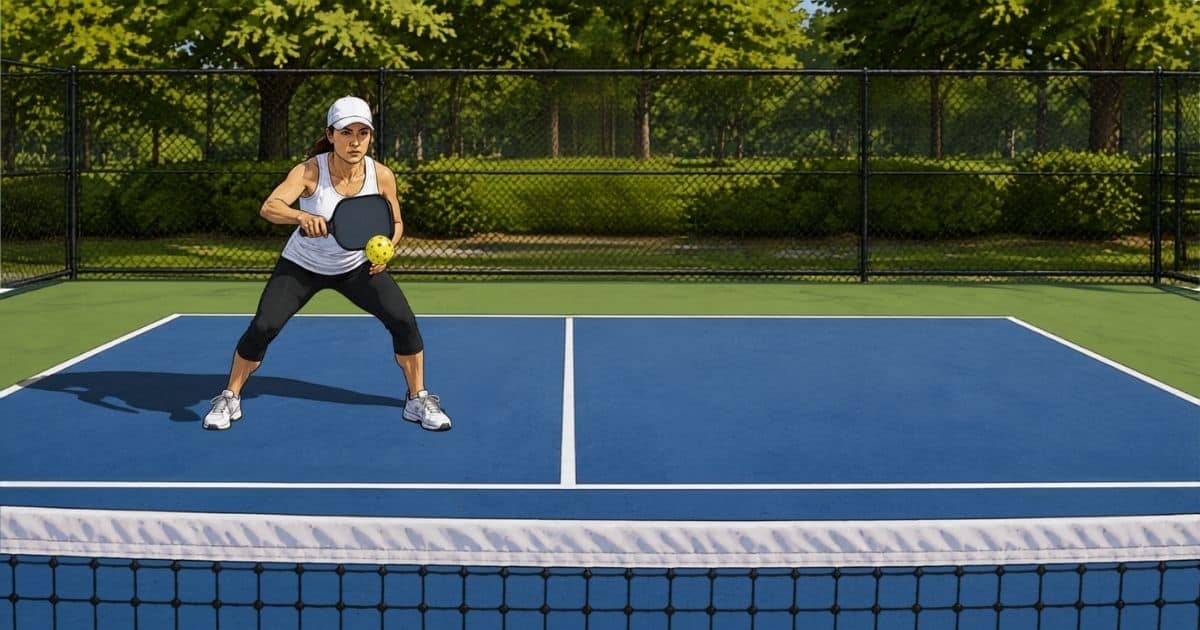
As your opponent makes contact, never after. Splitting early stops your forward momentum so you can push off in any direction, and a body that is still traveling forward cannot absorb anything.
Your feet also need to be apart rather than stacked together. A narrow base gets knocked off balance by a hard ball at the hip, and a wide, low base does not.
This is the single most common midcourt error. Players run three steps toward the kitchen, get caught mid-stride, and hit the reset while airborne.
Where Should the Paddle Be?
Low, out in front of the body, and already set before the ball arrives. The paddle face stays slightly open on the forehand side so the ball has somewhere soft to go.
Paddle out front matters more than paddle height. Contact that happens next to your hip or behind it gives you no room to absorb, and the ball rebounds off the face with whatever pace it arrived with.
Set the angle early and leave it. A paddle that is still moving at contact adds pace to a shot whose entire job is removing it.
How Do You Take Pace Off the Ball?
Loosen the grip and bend the knees. A relaxed hand absorbs pace, and a tight one bounces the ball back like a wall.
The mental cue that works is catching rather than hitting. Think about receiving the ball into the paddle face and letting it die there, the way a fielder gives with a hard-hit ball instead of stabbing at it.
Knee bend does the rest. Sinking before the ball arrives puts your eyes closer to the contact height and gets the paddle underneath the ball, and standing tall in the midcourt is how a reset turns into a pop-up. Get low before the ball gets there rather than while it is arriving.
Where Does the Reset Have to Land?
In the kitchen, ideally at your opponent’s feet. A ball that lands inside the non-volley zone cannot be volleyed, which forces the other team to let it bounce and gives you the time to finish your trip forward.
The standard is lower than most people assume. A reset that comes down onto their paddle, even without perfect depth, has already done its job by removing the attack. Perfect is not required.
Height over the net is what makes or breaks it. A reset that clears the net by a foot lands short and low. A reset that clears it by three feet lands somewhere attackable, no matter how soft the swing was.
How Do You Move Through No-Man’s Land?
In small steps, with a stop before every shot. The pattern is move, split, hit, move again, and the number of steps between shots is usually two or three.
The rhythm that works:
- Split step as your opponent contacts the ball.
- Absorb and drop the ball into the kitchen.
- Take two or three steps forward while the ball is traveling.
- Split again before their next contact.
- Repeat until you are at the kitchen line.
Getting all the way forward in one trip is optional. Two resets to cover the same ground beats one rushed reset hit on the run, and there is no penalty for spending an extra ball in the midcourt as long as you are stopped when you hit it.
Backing up is the one move to avoid. Retreating toward the baseline gives up the ground you just paid for, and a ball at your feet is easier to handle by getting low than by getting away from it.
What If the Reset Floats?
Check three things in this order: grip pressure, base, and paddle angle. A floating reset almost always traces back to a tight hand, a narrow or moving stance, or a face that was too closed at contact.
Tight grip is the usual culprit. A tense hand rebounds the ball with pace instead of soaking it up, and the extra pace shows up as height. Loosen the hand and the ball starts dying on the strings.
A reset that floats often feels fine off the paddle, which is why the cause is easy to miss. Opening the face slightly is the paired fix, since a closed face blocks the ball back rather than letting it settle.
One more thing to check is what happened before the shot. A reset that floats after a full-speed sprint forward is a footwork problem wearing a technique costume, and no amount of soft hands fixes it.
FAQ
What is a reset in pickleball? It is a soft shot that absorbs an opponent’s pace and drops the ball into the non-volley zone, taking the attack away from them. Resets are hit most often from the midcourt while moving forward. They turn a defensive position into a neutral one.
Where should a reset land? In the kitchen, and at your opponent’s feet if you can manage it. A ball landing inside the non-volley zone cannot be volleyed, so the other team has to let it bounce. Even a reset that simply comes down onto their paddle has removed their attack.
Why do my resets keep popping up? Usually grip pressure that is too tight, a paddle face that is too closed at contact, or a base that is too narrow or still moving. A tense hand returns pace instead of absorbing it. Start by loosening the grip and splitting your feet wider.
Should I split step in the transition zone? Yes, before every single shot. Split as your opponent makes contact rather than after, so your momentum is stopped and you can move in any direction. Hitting a reset while still running forward is the most common midcourt mistake.
How many steps should I take before I stop? Two or three between shots, then split again. Getting to the kitchen line in one trip is not the goal, and two clean resets beat one rushed one. There is no cost to spending an extra ball in the midcourt as long as your feet are stopped when you hit.
Can you reset from the baseline? Yes, though a soft ball from that far back has a long way to travel and gives opponents time to move in. From deep in the court, a third shot drop does the same job with a better margin, and our guide to the third shot drop covers that version.
Should I back up when the ball comes at my feet? No. Backing up surrenders the ground you already covered and puts you deeper in the least useful part of the court. Bend the knees, get the paddle out in front and below the ball, and absorb it where you are.
Is a reset the same as a dink? They share soft hands and a landing spot, and the situations differ. A dink is hit from the kitchen line in an already-neutral rally, while a reset is hit under pressure from the midcourt or the baseline to get back to neutral. The reset has to absorb pace that a dink usually does not face.
Resets come from drilling, and specifically from someone feeding you hard balls at your feet until the soft hands stop feeling strange. A coach can build that feed in one session, a clinic will run it for two days straight, and a quiet morning at one of the public courts near you is enough to keep it.
Written by the Pickler Junction Team.