Competitive Pickleball, Explained: Tournaments, Ratings, and How to Start
Quick Answer: Competitive pickleball means entering tournaments and leagues where results are recorded, brackets are seeded, and medals are awarded. Players enter by skill rating, age division, or both. Amateur entry fees commonly run $30 to $75 per event. USA Pickleball sanctioned play requires a Challenger or Champion membership, $12 or $60 a year as of August 2026.
Open play and tournament play are the same sport with different stakes. In open play the score resets and nobody writes it down. In a tournament somebody writes it down, it feeds a rating, and the rating decides who you face next time. That single difference is what people mean by competitive pickleball.
SFIA counted 24.3 million US pickleball players in 2025, up from 4.2 million in 2020. Only a fraction of that number ever registers for an event, which is why a first-time entrant in a 3.0 bracket is usually playing other first-time entrants rather than hardened veterans.
What Counts as Competitive Pickleball?
The ladder runs from casual to professional in about five rungs, each adding a layer of structure.
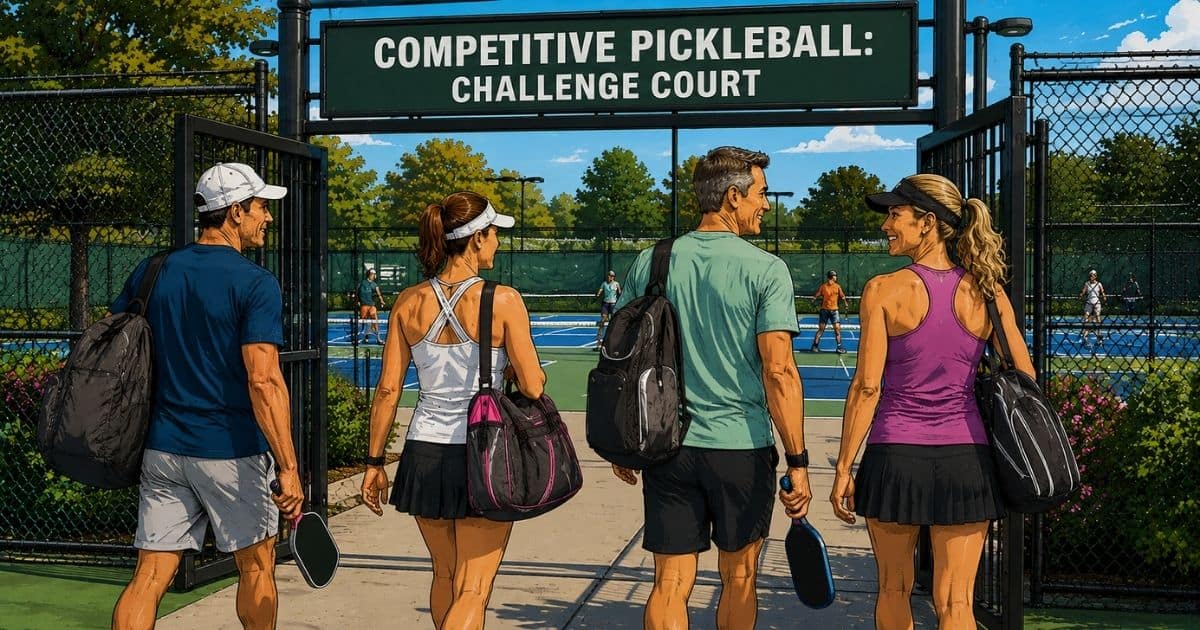
- Open play with challenge courts. Winners stay, losers rotate off. No record kept, but the sorting is real.
- Club ladders and in-house leagues. Standings tracked over weeks, usually a small fee and a fixed night.
- Unsanctioned local tournaments. Run by a club, a park, or a venue. Brackets, medals, entry fee, no national ranking points.
- USA Pickleball sanctioned tournaments. Results count toward the national ranking system and toward qualification for the National Championships. Entry requires an active Challenger or Champion membership.
- Pro tour events. The PPA Tour, the APP Tour, and Major League Pickleball, the first two of which run amateur brackets alongside the professional draws.
Most people who say they want to compete are asking about the middle three rungs. For the mechanical walkthrough of check-in, seeding, and medal rounds, see how pickleball tournaments work.
How Do Ratings Work in Competitive Pickleball?
Two systems matter, and they do different jobs.
Self-rating is the older approach. A player reads a written description of each skill level and picks the one that fits. It is still how many local and unsanctioned events place entrants, and it is the weak point of the system, because nothing stops a player from choosing a level below their actual ability. That practice has a name and a long argument attached, covered in the piece on sandbagging in pickleball.
DUPR is the algorithmic answer. DUPR states that its scale runs from 2.000 to 8.000 and that it keeps separate ratings for singles, gender doubles, and mixed doubles, plus age-group ratings for players 50 and older. It also publishes a Reliability Score from 1 to 100 percent reflecting how much match history sits behind the number. Verified club, league, and tournament matches move a DUPR rating more than self-posted scores do, which is the system’s defense against manipulation. The setup walkthrough is in the guide to getting a DUPR rating.
Plenty of 2026 events require a DUPR rating outright. The Powerball Florida Amateur State Championships listing on PickleballTournaments.com marks every skill-level division “DUPR Required,” so registering for DUPR before a first tournament is cheap insurance.
How Do Brackets and Age Divisions Work?
A tournament division is normally two filters stacked: a skill level and an age band. A 3.5 Men’s Doubles 50+ bracket takes men rated 3.5 who are at least 50 years old.
USA Pickleball revised its sanctioned age structure to 19+, 30+, 40+, and then 50+ and above, with the 50-and-over bands rising in 5, 10, or 15-year increments depending on the event. The organization said the change was made to promote fair competition and encourage more tournament play. The full breakdown, including how partners of different ages get placed, sits in the explainer on how age brackets work in pickleball.
Format is the tournament director’s call. USA Pickleball approves six formats for sanctioned events: single elimination with consolation, double elimination, round robin, pool play, non-pool play, and team play. Standard games are two out of three to 11, win by 2. The Dink Pickleball notes that most events guarantee at least two matches per player, with a loss dropping you into the consolation side rather than out of the building.
Juniors get their own structure. USA Pickleball Golden Ticket events run co-ed junior divisions at 12 and under, 13 to 14, and 15 to 16. The Junior PPA Tour runs 12U, 14U, 16U, and 18U in boys’ and girls’ singles and doubles plus combined mixed, capped at players under 5.5 DUPR. The wider youth landscape is mapped in the guide to junior pickleball leagues.
What Does It Cost to Enter a Tournament?
Budget for three separate line items: membership, registration, and per-event fees.
Membership. USA Pickleball lists a free Casual tier, Challenger at $12 a year, and Champion at $60 a year as of August 2026. Sanctioned tournaments, Golden Ticket events, and Nationals all require an active Challenger or Champion membership.
Entry. The Dink Pickleball puts most amateur events at $30 to $75 per event entered as of August 2026, and real 2026 listings run from inside that range up to the mid-$90s at larger state events. The APP Overland Park Open on September 17 to 20, 2026 lists a $40 amateur entry against $160 for the pro division. The Powerball Florida Amateur State Championships on May 15 to 17 charged $70 early, $85 regular, and $95 late, with up to two events included and $30 for each additional event.
Marquee events cost more. The US Open Pickleball Championships charges a $150 registration credential on top of event fees, with amateur events at $45 for doubles and $50 for singles, juniors at $35 for the credential and $25 per event, and optional registration and weather insurance at $25. That is a different budget line from a Saturday club tournament, and the full picture is in the guide to the US Open Pickleball Championships.
Add travel and lodging, since most brackets run one day but most events span three or four. Two events in one weekend at a regional tournament commonly lands between about $75 and $150 in entry and membership fees, before travel and hotels.
What Are the Pro Tours, and Do Amateurs Play Them?
Most of the American professional calendar runs through three organizations, and two of them sell amateur entries.
PPA Tour. The Carvana PPA Tour describes itself as running 20 tour stops a year with more than $30 million distributed to professional athletes annually. Each stop runs five pro divisions, men’s and women’s singles, men’s and women’s doubles, and mixed doubles, plus amateur and junior brackets. Entering the amateur draw puts you on the same site as the pros, not on the same court.
APP Tour. The APP announced 12 US tour events for 2026 with national television coverage on CBS Sports and ESPN, open to amateurs of all ages and skill levels alongside the pro fields. The APP also runs AARP Champions for players 50 and older and AARP Masters for players 60 and older across ten 2026 stops, plus APP Next development events for athletes 23 and under.
Major League Pickleball. MLP is a team league rather than an open tournament. It fielded 20 hometown teams for a 2026 season of 13 events running May through August, with each match built from women’s doubles, men’s doubles, and two mixed doubles games, then a DreamBreaker singles tiebreaker played to 21 with rally scoring and player swaps every four points.
Champions Series Pickleball, launched in 2022 as the National Pickleball League, runs 16 teams across Prime 40+, Champions 50+, and Masters 60+ divisions. That world is covered in the piece on the senior pro pickleball circuit, and the national picture is sorted out in the rundown of major US pickleball tournaments. The Oceanview USA Pickleball National Championships run October 31 to November 8, 2026 at Barnes Tennis Center in San Diego.
How Does a First Tournament Actually Go?
Here is the shape of a normal amateur day, drawn from The Dink Pickleball’s account of entering a first event.
Check-in opens one to two hours before the first match. You get a wristband, a bracket sheet, and a court assignment that will change. Amateur brackets are usually self-officiated, so both sides call their own lines. Events commonly run four to eight hours depending on how many divisions share the venue.
The specific things that surprise first-timers:
- Waiting dominates the day. Bring food, water, a chair, and a second shirt.
- The warm-up is short. Some directors allow a few minutes on court, some allow none, so warm up off court before your name is called.
- Scores are called out loud, every serve. In open play people mumble it. In a bracket, calling the score before serving is the rule.
- A loss is not the end. Consolation brackets exist so the entry fee buys more than one match.
- Partner selection matters more than shot selection. A steady partner who returns serve deep will outperform a flashy one in a 3.0 bracket.
The registration mechanics, including how the major platforms handle waitlists and partner requests, are in the guide to signing up for a pickleball tournament.
What Do Two Real City Calendars Look Like?
Two metros show how differently the same national calendar lands locally.
Phoenix. The APP lists an Arizona Open on its 2026 tour schedule running November 12 to 15, carrying both the AARP Champions and AARP Masters divisions. Around it sit club events and winter-season tournaments running roughly October through April, when the desert is playable outdoors all day. The month-by-month picture is kept in the Phoenix pickleball tournament calendar.
Kansas City. The metro’s headline event is the APP Overland Park Open, September 17 to 20, 2026 at AdventHealth Sports Park at Bluhawk in Overland Park, Kansas. Amateur entry is listed at $40, with AARP Champions Pro at $140 and AARP Masters Pro at $120. That is a tour-grade event inside a metro whose remaining schedule is club-run, a common Midwest pattern. Local listings sit in the Kansas City pickleball tournament calendar.
Florida runs on a different clock again, with a winter-heavy calendar built around Naples, broken down in the guide to pickleball tournaments in Florida.
Frequently Asked Questions
Do I need a DUPR rating to enter my first tournament? Not always, but increasingly yes. Many 2026 skill-level divisions list DUPR as a requirement, including every skill division at the Powerball Florida Amateur State Championships. Creating a DUPR profile costs nothing and takes a few minutes, so do it before registration opens rather than the night before.
What rating should I enter at? Enter at the level your recorded results support. If you have a DUPR, use it. If you are self-rating, use the level you actually beat in open play more often than you lose, not the level you beat on your best day.
Do I need a partner to enter a doubles bracket? Usually yes for the entry itself, though many tournaments run a partner-finder board or waitlist that matches solo entrants. Some events let you register and add a partner before a stated deadline.
How many matches will I get for my entry fee? Most amateur brackets guarantee at least two, because a first-round loss drops you into a consolation bracket rather than out of the event. Round robin divisions guarantee more.
Is USA Pickleball membership required for every tournament? Only for sanctioned events, Golden Ticket events, and Nationals, which require an active Challenger or Champion membership. Unsanctioned club and venue tournaments set their own rules.
What is the difference between the PPA, the APP, and MLP? The PPA and APP are tournament tours with pro and amateur draws at the same site. MLP is a team league with drafted rosters, a four-game team format, and a DreamBreaker singles tiebreaker. Amateurs can enter PPA and APP events. MLP rosters are professional.
Can juniors and seniors compete in the same tournaments as everyone else? They compete at the same events in their own divisions. Junior brackets at USA Pickleball Golden Ticket events run at 12 and under, 13 to 14, and 15 to 16, and the APP runs AARP Champions at 50 and older and AARP Masters at 60 and older.
How far in advance should I register? As soon as registration opens for anything popular. The US Open ran a general lottery registration window of January 14 to 20 for its 2026 event, with winners notified January 28 and payment due February 3, which is a schedule that punishes procrastination.
What should I bring to a first tournament? A second paddle if you own one, food, water, sunscreen, a folding chair, and a change of shirt. Confirm your paddle appears on the approved equipment list if the event is sanctioned.
Getting into competitive pickleball is mostly logistics. Find an event, confirm the rating requirement, pick a division, register early, and show up early. A local club is the fastest route to a partner and the local calendar, a coach can tell you honestly which bracket you belong in, and the tournaments and events directory lists what is coming up near you.
Written by the Pickler Junction Team.