
How to Find a Pickleball Partner
Quick Answer: For a regular playing partner, open play is the best hunting ground because it puts you with roughly twenty players in a single session. For a tournament partner, look for someone within about half a rating point of you whose game complements yours. Reliability matters more than skill in both cases.
Finding a pickleball partner means locating someone to play with regularly, which is a different problem from finding a court or joining a session.
What kind of partner are you looking for?
Three different searches, and confusing them wastes time.
A regular hitting partner for drilling. Needs to be available when you are and interested in practice rather than only games. Level matters less than commitment.
A doubles partner for league or ladder play. Needs to be close to your level and available on a schedule.
A tournament partner. The most demanding search. Level, temperament, availability and complementary style all matter, and you are committing to entry fees together.
Where do you find one?
In rough order of how well it works.
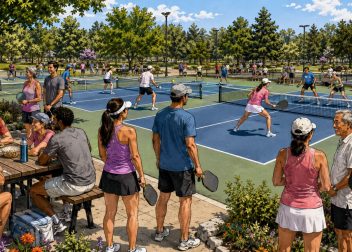
1. Open play. You will typically play with roughly twenty people in a session. That is twenty auditions, and it costs nothing. See what open play is.
2. A local Facebook group. Posting what you are looking for works, and these groups exist in most towns.
3. A ladder or flex league. Both assign partners, which is the lowest-effort way to meet potential ones. See what a flex league is.
4. A clinic. Everyone there is at a similar level and looking to improve, which is a strong filter.
5. Your club’s board or group chat, if you belong to one.
What makes a good doubles partner?
Not the strongest player available, which is the mistake most people make.
Reliability. Someone who turns up when they said they would is worth more than a better player who cancels. This is the single most common reason partnerships end.
Temperament. How they behave after a bad point tells you more than how they hit. A partner who sulks or criticizes will cost you more matches than their skill wins.
Complementary style. Two bangers is a worse pairing than a banger and a resetter. Two players who both want the middle is worse than one who takes it.
Communication. Talking between points is most of doubles. A silent partner is a hard partner.
Similar goals. Someone who wants to compete paired with someone who wants a social game will frustrate each other by the second tournament.
How do you ask?
Directly and with a low-stakes first step.
The version that works: play with someone at open play, and if it clicked, say so and suggest one specific thing. A drill session on Thursday. One local tournament. Not an open-ended partnership.
That framing lets both sides discover whether it works without anyone having to end anything. Most durable partnerships start with one session rather than a commitment.
How do you end one?
Cleanly, early, and in person if possible.
Partnerships that are not working produce more resentment than almost anything else in recreational pickleball, largely because people avoid the conversation. Saying you want to try playing with some other people for a while is a normal thing to say and it is far kinder than becoming unavailable.
If the issue is level rather than fit, say that plainly too. Most people would rather hear it than guess.
FAQ
How do I find a pickleball partner?
Open play is the most efficient route, since you will typically play with roughly twenty people in one session. Local Facebook groups and ladder leagues also work well.
What makes a good doubles partner?
Reliability first, then temperament, then complementary style. The strongest available player is often not the best choice.
Should my partner be the same level as me?
Within about half a rating point is a reasonable rule for competitive play. Bigger gaps work socially and cause problems in tournaments.
How do I ask someone to be my partner?
Suggest one specific low-stakes thing, a drill session or a single local event, rather than an open-ended partnership.
What if my partner is much better than me?
It works fine socially and tends to frustrate both people in competition, because the stronger player covers more and the weaker one gets targeted.
How do I end a partnership?
Say it plainly and early. Wanting to play with some other people for a while is a normal thing to say and it is kinder than quietly becoming unavailable.
Where do I find a drilling partner specifically?
Ask at open play. Plenty of players want to drill and cannot find anyone, which makes this an easier ask than most people expect.
Do apps help?
Some scheduling and finder apps include partner matching. A local Facebook group usually works better because the people are already nearby.
If you are still looking for a session to hunt in, our court and club listings cover what is near you.
Written by the Pickler Junction Team.